What does it take to turn a real estate buyer’s interest into a booking?
According to Privyr’s latest survey, the answer is several more conversations.
We surveyed 63 real estate organisations across India, representing approximately 300 property consultants, to compare their customer interaction experience of the 2026 festive season with those during the 2025 Diwali season.
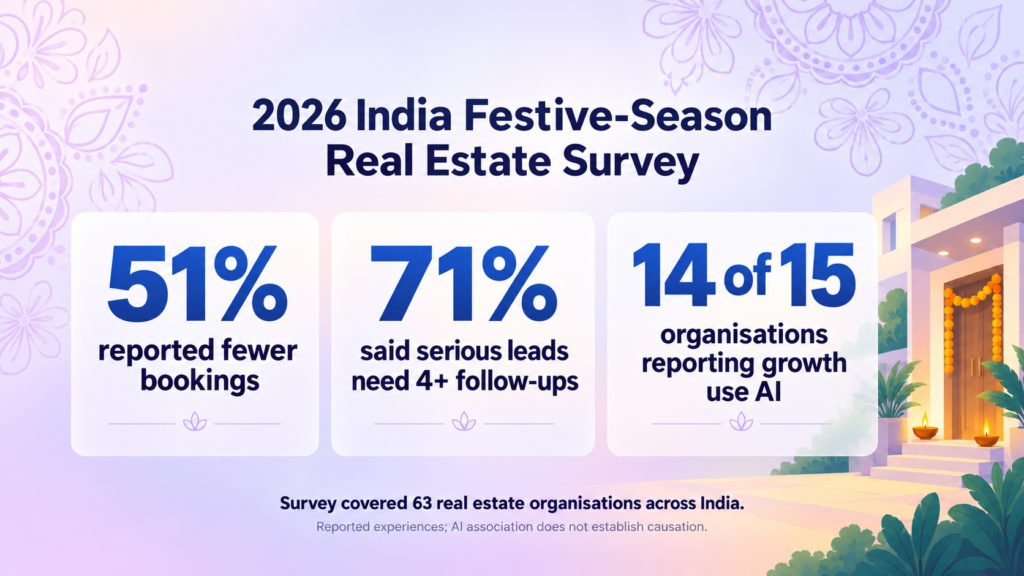
More than half of the respondents reported fewer bookings, with buyers’ budget constraint cited as the most frequent obstacle to closing. Meanwhile, 71% said converting a serious lead into a booking takes at least four follow-ups, with 44% reporting it takes eight or more.
The survey also revealed an interesting pattern in AI adoption: Of the 15 organisations that reported higher bookings, 14 use AI. Most of that usage involved everyday tasks such as drafting messages and creating sales materials.
These findings offer a snapshot of the real estate customer conversations, persistence, and tools behind the festive-season property booking.
How festive bookings changed from 2025 to 2026?
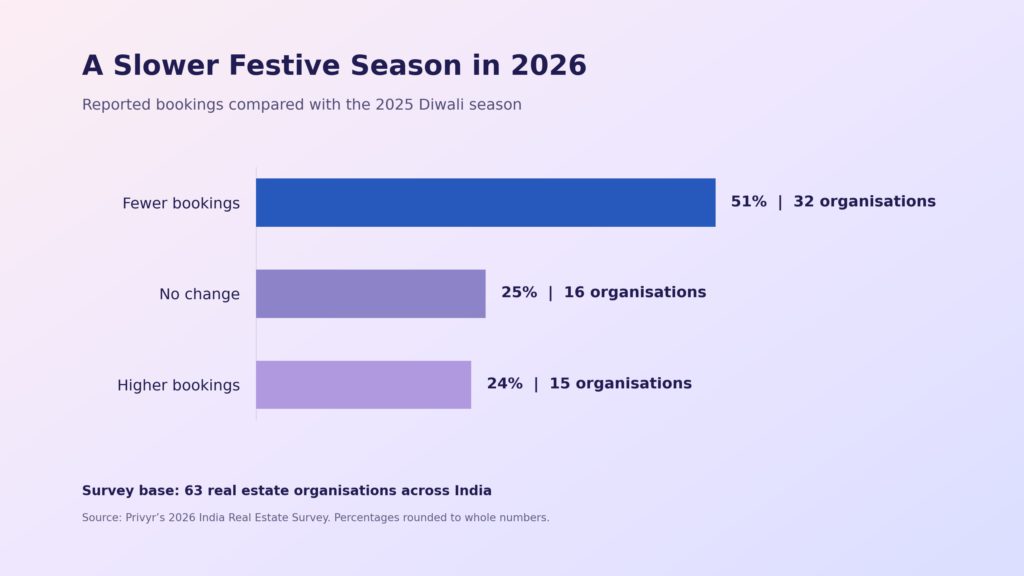
This year’s festive season brought mixed results for the organisations we surveyed:
- 51% reported fewer bookings than during the 2025 Diwali season.
- 24% reported higher bookings.
- 25% reported no change.
These figures describe the share of organisations reporting each outcome. They do not measure the overall increase or decrease in property bookings.
So what stood between buyer interest and a booking?
Price hesitation.
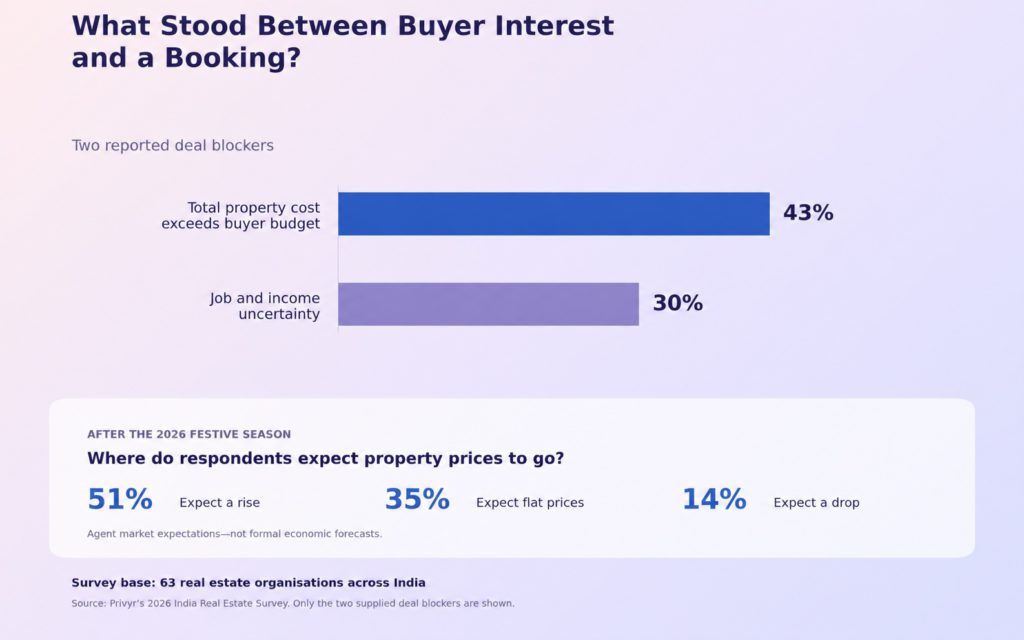
For 43% of respondents, the biggest obstacle was property cost exceeding the buyer’s budget. 30% identified job and income uncertainty.
Additionally, according to the respondents, buyers’ budget constraints further lengthen the sales cycle.
Buyers often take time to explore financing options, compare listings, consult family members, or wait for market conditions to change. For real estate salespeople, that means keeping existing conversations moving while also working on new enquiries.
Looking ahead, 51% of respondents expect property prices to rise after the 2026 festive season, 35% expect flat pricing, and 14% predict a drop. (*These reflect agent market expectations rather than formal economic forecasts.)
A serious lead can still be several follow-ups away from a booking
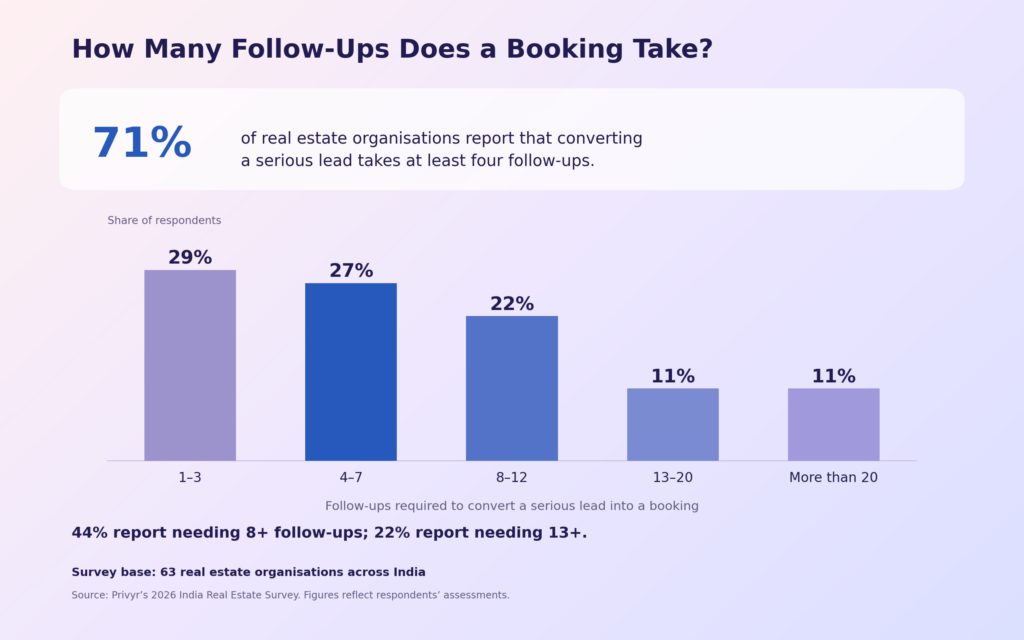
Buyer interest is a good starting point. However, closing requires many consistent follow-ups according to most respondents.
71% of the 63 organisations surveyed said a serious lead takes at least four follow-ups to convert into a booking.
The effort extends much further for a substantial share:
| Follow-ups required | Share of respondents |
| 1–3 | 29% |
| 4–7 | 27% |
| 8–12 | 22% |
| 13–20 | 11% |
| More than 20 | 11% |
Altogether, 44% reported needing eight or more follow-ups, including 22% who said it takes at least 13.
Although these are respondents’ assessments, rather than an average calculated from individual lead records across the Indian real estate industry, these numbers still highlight the operational challenge of keeping a buyer conversation useful across multiple interactions.
For property agents, each follow-up is a chance to answer unanswered questions and help a buyer move closer to a decision. That can become harder when they have to piece together previous conversations from cluttered notes and chat histories.
A dedicated mobile workflow can keep important client details within reach. Agents pick up where they left off and follow up at the right time, without having to deal with manual CRM reporting.
Firms reporting higher bookings use more AI
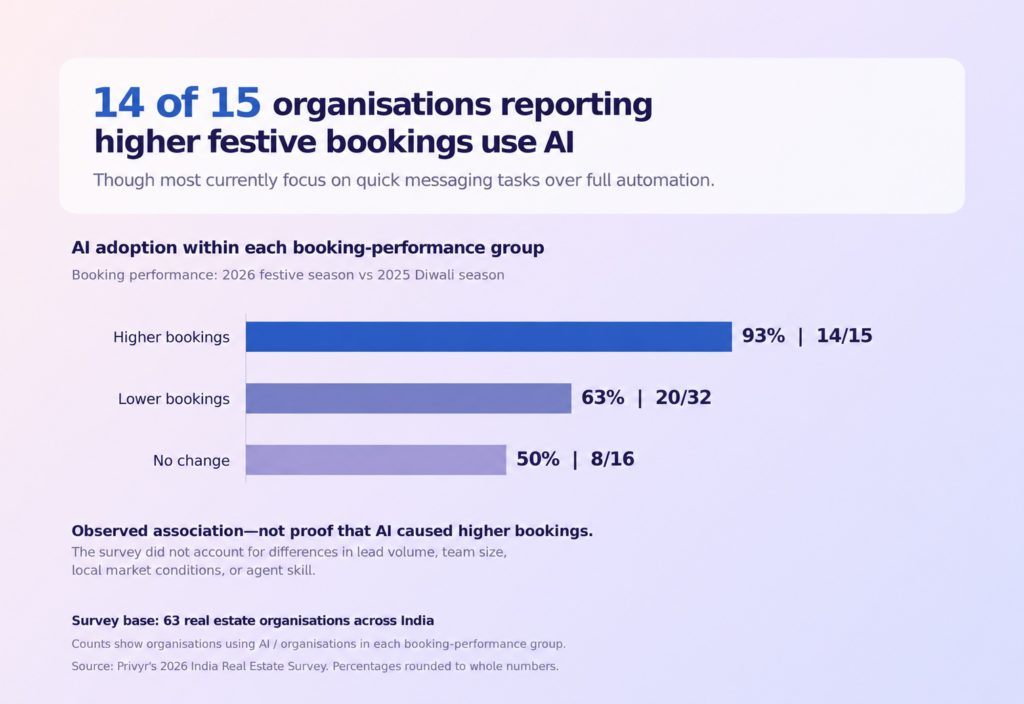
The survey highlighted an interesting correlation between booking growth and AI implementation.
Of the 15 organisations reporting higher festive bookings, 14 use AI in some form.
AI adoption was lower among the other two groups: 20 of the 32 organisations reporting fewer bookings use AI, compared with eight of the 16 reporting no change.
| Booking performance: 2026 festive season vs 2025 Diwali season | Organisations surveyed | Organisations using AI |
| Higher bookings | 15 | 14 (93%) |
| Lower bookings | 32 | 20 (63%) |
| No change | 16 | 8 (50%) |
Here’s how these high growth teams deploy AI:
- 10 use AI for lighter tasks, like drafting follow-up text scripts.
- 3 use AI for asset creation such as generating property PDFs and banners.
- 1 uses AI for end-to-end automation, including WhatsApp AI sequences.
- 1 is not currently using AI but plans to adopt it shortly.
The difference in AI usage is interesting, but it needs a little bit of context. The survey did not account for differences in lead volume, team size, local market conditions, or agent skill.
The finding shows an association within this sample and does not establish that AI caused bookings to increase. However, it highlights that automating repetitive tasks could give agents more time to sell.
Additional findings: What buyers want?
The survey also captured respondents’ observations about real estate buyer preferences.
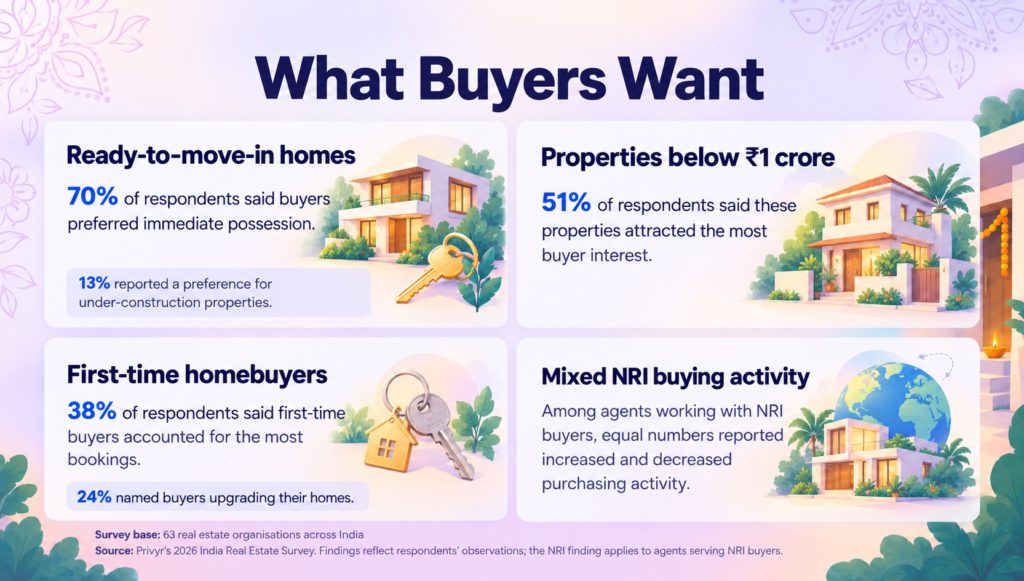
Ready-to-move-in homes were the most commonly reported preference. 70% of respondents said buyers preferred homes available for immediate possession, compared with 13% who reported a preference for under-construction properties.
Properties below 1 crore dominated demand. 51% of respondents said these properties attracted the most buyer interest.
First-time homebuyers were the leading buyer group. 38% of respondents said first-time buyers accounted for the most bookings, followed by buyers upgrading their homes at 24%.
NRI buying activity showed a mixed picture. Among agents working with NRI buyers, equal numbers reported an increase and a decrease in purchasing activity.
Key takeaways for real estate teams
Privyr’s 2026 India real estate survey findings point to three areas real estate sales leaders can review:
- Address affordability early. With price and income uncertainty the most frequently cited obstacles, real estate reps should be ready to discuss costs clearly and respond accurately to buyers’ financial questions.
- Make every follow-up useful. The survey doesn’t show how many follow-ups work best, but it highlights the need to track past conversations, note unanswered questions, and plan the next step.
- Evaluate technology. Identify your repetitive tasks, then assess whether a tool or AI can streamline it. Personalised message drafting, material preparation, or follow-up can be the possible areas you can examine.
About the survey
Privyr surveyed 63 real estate organisations across India, representing approximately 300 property consultants, during the 2026 festive season. Respondents compared their current booking performance with the 2025 Diwali season.
The analytical sample consists of 63 organisations. “Approximately 300 consultants” refers to their combined representation and should not be treated as 300 independent responses.
51% of respondents operated in Tier 1 cities and 24% in Tier 2 cities, with the remainder spread across Tier 3, Tier 4, and rural markets.
The findings show respondents’ reported experiences and observations. They provide a snapshot of the surveyed organisations rather than a comprehensive picture of India’s real estate market.
Percentages are rounded to whole numbers. Totals may vary slightly.
About Privyr
Privyr is an AI-powered, mobile-first CRM designed to help sales teams manage their sales process from their smartphones. It brings together lead capture, auto-responses, follow-up reminders, and team activity tracking, alongside WhatsApp AI sales agents for teams that sell primarily through WhatsApp.
2026 India real estate survey key findings summary
- Bookings vs. 2025 Diwali season: 51% reported lower bookings, 24% higher bookings, and 25% no change.
- Post-festive price expectations: 51% expect property prices to rise, 35% expect flat prices, and 14% expect a drop.
- Primary deal breaker: 43% cited total price exceeding budget, 30% job/income uncertainty, 16% expectation of lower future prices, 8% weak festive promotions, and 3% home loan interest rates.
- Strongest demand price tier: 51% identified properties under 1 crore, 19% 1–2 crore, 14% saw no dominant tier, 10% 2–5 crore, and 6% above 5 crore.
- Top closing buyer demographic: 38% identified first-time buyers, 24% upgraders, 24% saw no clear pattern, 10% holiday-home buyers, and 5% NRI investors.
- Property completion preference: 70% preferred ready-to-move-in homes, 13% preferred under-construction projects, and 17% noted no distinct trend.
- NRI client activity: Among agents serving NRIs, 39% reported higher interest, 39% lower interest, 17% inactive, and 5% net selling.
- Follow-ups required to close: 71% report needing 4 or more follow-ups; 44% require 8 or more; 22% require 13 or more.
- AI adoption & performance link: 67% overall use AI for lead management or admin tasks. By performance tier: 93% of teams with higher bookings use AI (14 of 15), compared to 63% with lower bookings (20 of 32), and 50% with unchanged bookings (8 of 16). (Observed correlation, not proven causation.)