Contents
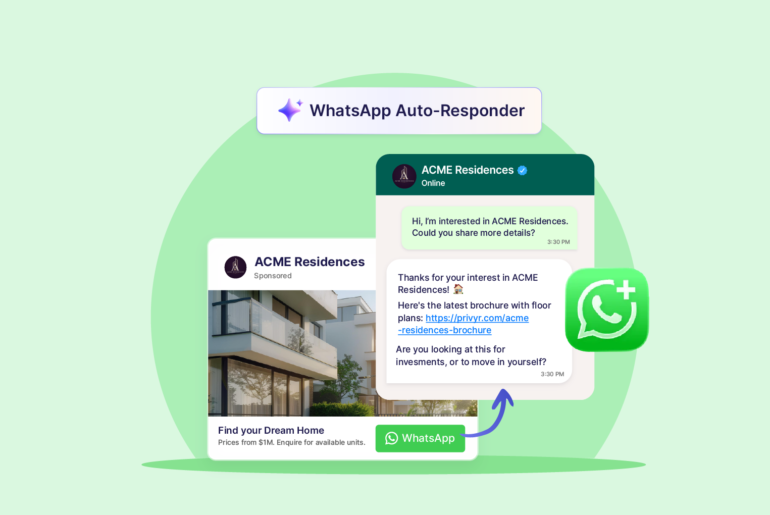
As of August 2026, a few platforms, including Privyr fully support WhatsApp Usernames and Business scoped user Ids (BSUIDs) and allow you to run campaigns and communications normally.
WhatsApp is slowly rolling out WhatsApp usernames for its 3.3 billion monthly active users after it recently announced username reservations. Having a username means a WhatsApp user no longer needs to disclose their phone number to communicate on WhatsApp.

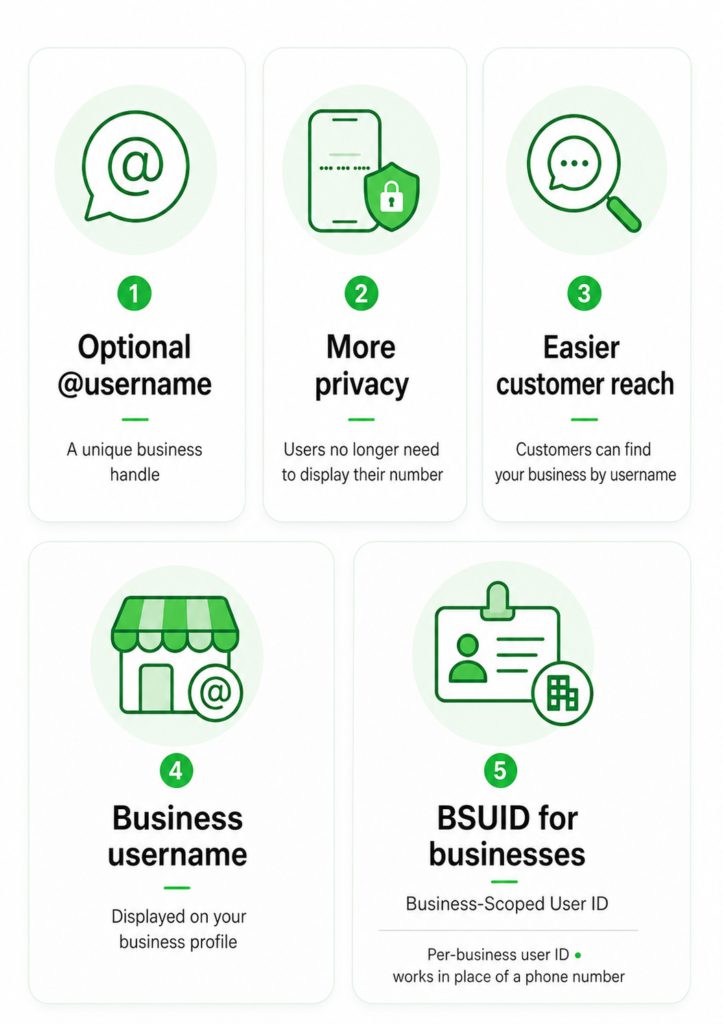
So how does WhatsApp manage businesses that have been identifying users with their phone numbers? Well, if you’re a business, WhatsApp will provide you with Business scoped user Ids (BSUIDs) instead of user numbers for identifying users. But BSUIDs will be unique to each business.
This can change more than what appears at the top of the chat, especially if your business relies on WhatsApp for sales communications because many CRMs, WhatsApp marketing tools, and campaign platforms are originally built around contacting users on their WhatsApp through their phone number.
As these changes happen gradually, many campaigns and integrations may face disruptions if your platform doesn’t yet support WhatsApp usernames (or BSUIDs). This can have a huge impact on your sales if it depends on WhatsApp conversations.
Now the question is: Does your sales platform support WhatsApp Usernames? And how to adopt your operations and tools to this change. Let us help you!
Which sales and marketing platforms currently support WhatsApp Usernames?
As of August 2026, a few platforms including Privyr, Salesforce, Freshsales suite, SleekFlow, etc have documented support for WhatsApp’s new username model. How you deal with BSUID-only contacts can vary based on platforms.
The table below details how major CRMs are adopting WhatsApp Usernames as of August 2026:
| Platform | Username / BSUID support | Campaigns / broadcasts | Automations / sequences | Important limitations |
| Privyr | ✅ Yes | WhatsApp Campaigns, Broadcasts, BSUID contacts | Auto-Responder, Sequences, and WhatsApp Automations | Some workflows may depend on the phone number provided by the lead source |
| Salesforce | ✅ Yes | Outbound WhatsApp campaigns to BSUID contacts | Marketing Cloud journeys and WhatsApp automations | As of 27 August 2026, Salesforce’s documentation states that the features described “don’t become generally available until the latest general availability date that Salesforce announces for this release” |
| Freshsales Suite | ✅Yes | WhatsApp campaigns, multi-step workflows. | Automated customer journeys, multi-step follow-ups | Authentication templates may still require a phone number. |
| SleekFlow | ✅Yes | Messaging/broadcast functionality supported | Existing Flow Builder automations continue | Sending to BSUID through its API isn’t currently supported |
| Zoho CRM | ⚠️ Not clear | Marketing WhatsApp templates are supported, but BSUID-only broadcasts aren’t documented. | WhatsApp messages can be added to the workflows, but whether these work with BSUID-only contacts isn’t documented. | Zoho CRM’s current WhatsApp documentation still describes contacts and sending largely around phone numbers. As of 20 August, 2026 it hasn’t released any documentation confirming BSUID support. |
| HubSpot | ⚠️ Possibly phone-number dependent / not clear | WhatsApp templates can be sent through workflows, but BSUID-only sending isn’t documented. | WhatsApp messages can be automated through HubSpot Workflows, but HubSpot currently says the contact must have a valid WhatsApp Phone Number populated. | HubSpot’s July 2026 documentation explicitly requires a valid WhatsApp phone number for workflow/template sending, so BSUID-only automation is currently unclear. |
| Pipedrive | ⚠️ Not clear | Its native WhatsApp integration supports conversations and template messages, but BSUID-only broadcasts isn’t confirmed | Not clear. The native WhatsApp integration documents replies and template messages, but not WhatsApp automation or sequences. | As of August 20, 20226, Pipedrive is yet to release any official documentation announcing support for BSUID-only contacts |
| Monday CRM | ⚠️ Not clear | Supports campaigns, but its documented campaign features are email-based rather than native WhatsApp broadcasts. | Sequences support automated/manual emails, tasks and call tasks, but WhatsApp sequences aren’t documented. | As of August 20, 20226, Monday CRM hasn’t released any official documentation announcing support for BSUID-only contacts |
| LeadSquared | ⚠️ Not clear | WhatsApp marketing campaigns and bulk messages are supported, but BSUID-only campaign recipients are not documented. | WhatsApp notifications, reminders and automated messages are supported, but BSUID compatibility is unclear. | As of August 20, 20226, LeadSquared hasn’t released any official documentation announcing BSUID-only contacts support |
Why should you have a platform that supports WhatsApp Usernames now?

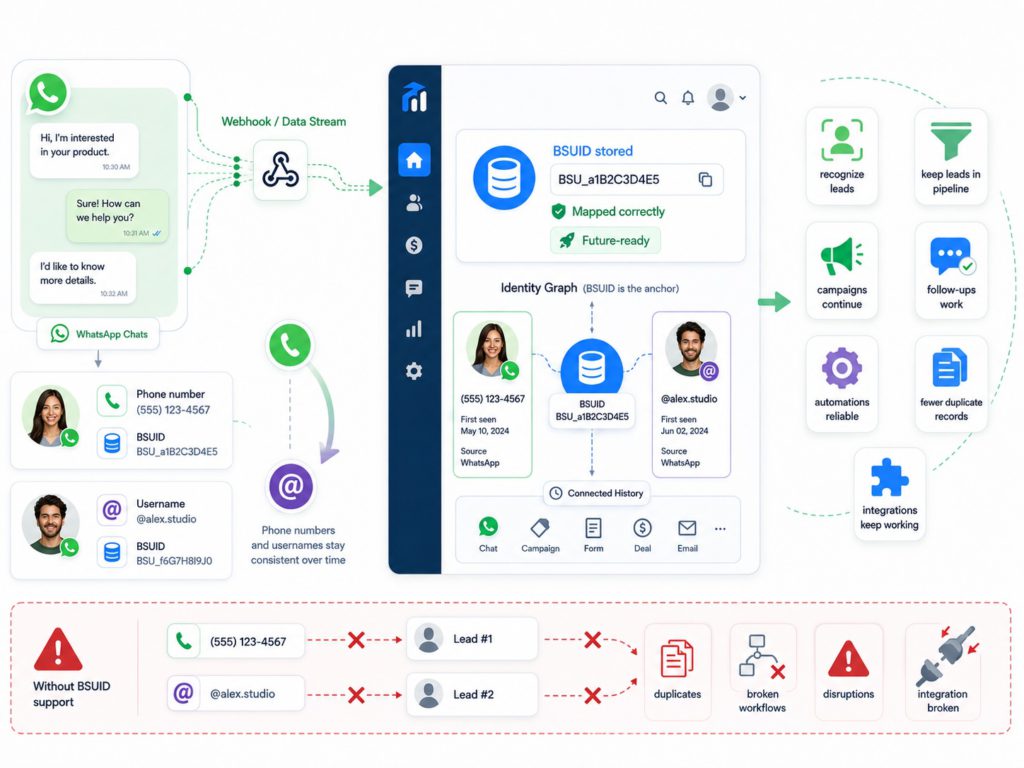
As WhatsApp gradually rolls out WhatsApp Usernames, WhatsApp webhooks already include the Business-Scoped User ID (BSUID) even when the user has not enabled a username. Current webhook can contain the phone number plus the BSUID since the phone number is still mostly available.
The advantage of having a platform that supports WhatsApp Usernames in the initial stages is that it stores the BSUID alongside existing customer identifiers, so future conversations can be mapped correctly when the phone number is no longer available.
If your sales tool doesn’t support BSUIDs, your future WhatsApp communication and workflows could be disrupted. As more people start using usernames instead of sharing their phone numbers, activities like managing leads, follow-ups, automations, and customer records may become much messier.
A sales platform supporting WhatsApp Usernames in the early stages will allow you to:
- Keep recognising leads even when their phone number is hidden
- Keep username-only leads in your sales pipeline
- Continue WhatsApp campaigns without collecting a phone number first
- Run follow-up sequences for username-only leads
- Make WhatsApp automations more reliable
- Reduce duplicate and disconnected customer records
- Keep integrations working when phone numbers disappear
Sales and marketing workflows WhatsApp Usernames can affect
Most sales and marketing tools that support WhatsApp are traditionally based on phone numbers when it comes to WhatsApp contacts. If the platforms aren’t updated to support Usernames, your workflows can break.
If your sales and marketing tools don’t recognise a customer by their BSUID when there is no phone number available, the following can be affected:
1. Click-to-WhatsApp Ads

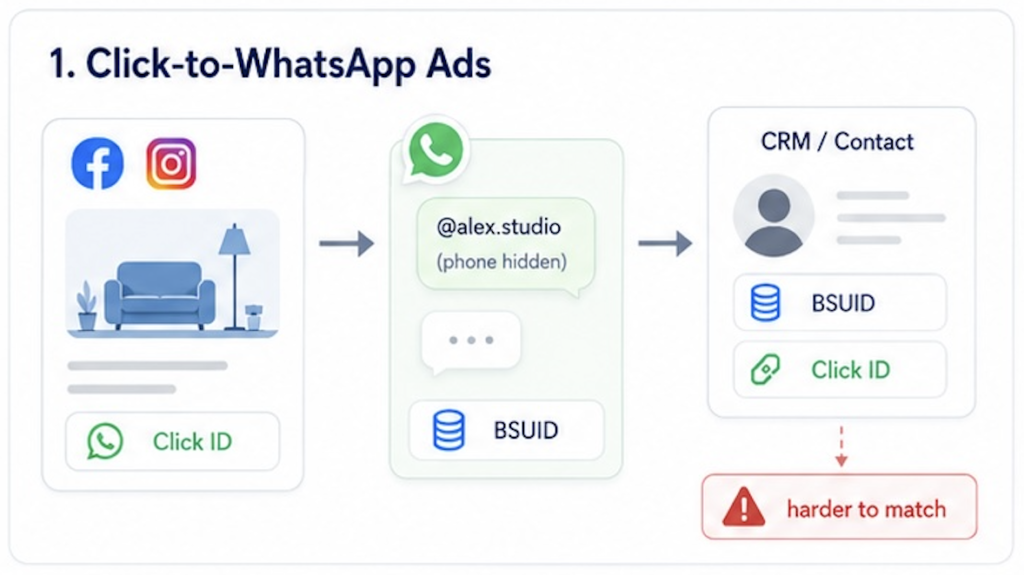
When you run Click-to-WhatsApp Ads, leads click an ad on Facebook or Instagram and start a WhatsApp conversation with your business.
With WhatsApp Usernames, leads may now enter the conversation without sharing their phone number and your WhatsApp system will receive their BSUID instead of phone numbers.
This doesn’t necessarily break ad attribution as Meta provides a separate Click-to-WhatsApp Click ID for messages that come from Click-to-WhatsApp ads. This ID can be passed to Meta’s Conversions API to connect later actions, such as a lead or purchase.
However, matching the lead outside that WhatsApp conversation may be difficult. For instance, If your CRM or sales tool doesn’t recognise the BSUID, it may fail to create the contact, process the conversation, or connect later sales activity to that lead.
Tools that support BSUIDs store Meta’s Click-to-WhatsApp Click ID for ad attribution and can also handle BSUIDs when a customer’s phone number is unavailable.
2. CRM databases

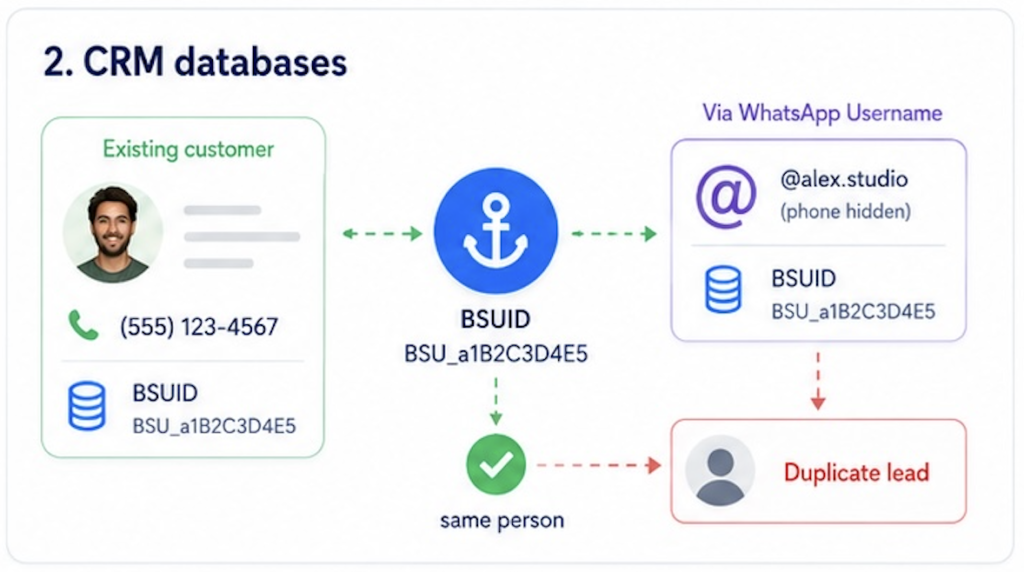
Traditional WhatsApp integrations use phone numbers to find and match contacts.
Imagine you already have a customer named Sarah in your CRM. Your tool may store Sarah’s information as follows:
Sarah Jones
+1 123 456789
Bought a property in 2021
Interested in another property
If Sarah messages your business later using a WhatsApp Username and WhatsApp doesn’t share her phone number, your salesperson may see Sarah as a brand-new lead instead of an existing customer.
Similarly, if a warm lead messages another rep using a WhatsApp username, a platform without BSUID support may fail to link them to their existing record. The rep could miss the lead’s previous conversations and sales progress and treat them as a new lead.
Platforms like Privyr automatically store BSUIDs and allow contacts to exist without phone numbers and merge duplicate contacts when they match.
3. Chatbots and Autoresponders

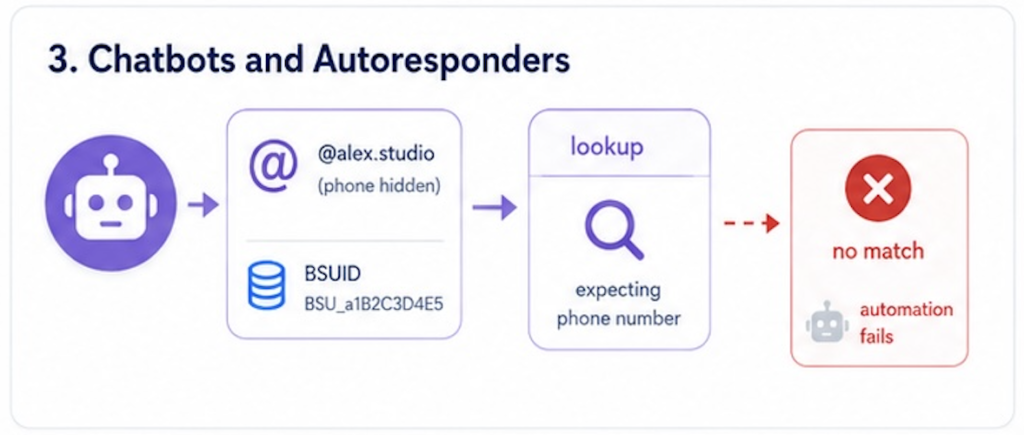
WhatsApp integrations traditionally receive fields such as “from” containing a phone number. With Username-only users, that same field can contain a BSUID when the phone number isn’t available.
If an old customer contacts you on WhatsApp with a username, the workflow will search the database using the BSUID as a phone number and fail to match the customer or conversations.
4. WhatsApp campaigns and opt-ins

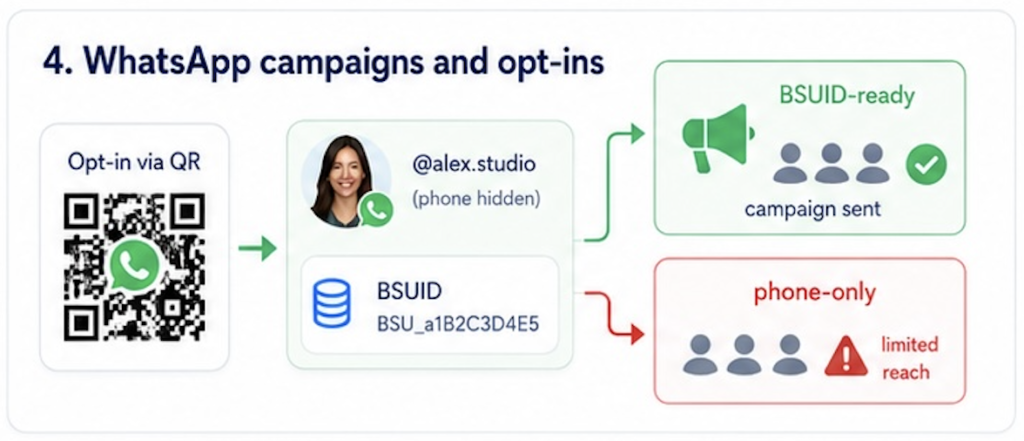
Let’s suppose an existing customer scans a QR code, starts a WhatsApp conversation and opts in to your offers. But they use a WhatsApp Username and don’t share their phone number.
A BSUID-ready platform can keep that contact in your WhatsApp audience, message them using their BSUID, and link that identity to a phone number already stored on their record. But if you have older broadcasting tool designed around accepting phone numbers, you can’t simply take their WhatsApp identity and use it for SMS campaigns, sales calls, CRM matching, and more
Keep in mind that BSUID is only useful within the business that created it. The same WhatsApp user will have a different BSUID with another business, and the ID itself doesn’t contain any user details. You can’t simply share BSUID between platforms to share the user information.
A hidden phone number doesn’t mean you can’t market a lead on WhatsApp. But having a WhatsApp marketing system built only around phone numbers can have limitations now.
Meta’s Marketing Messages API already supports sending marketing messages using a BSUID. Platforms like Privyr support BSUID-only contacts in broadcasts and workflows, and can send WhatsApp campaigns to customers without requiring a phone number.
5. Customer support platforms

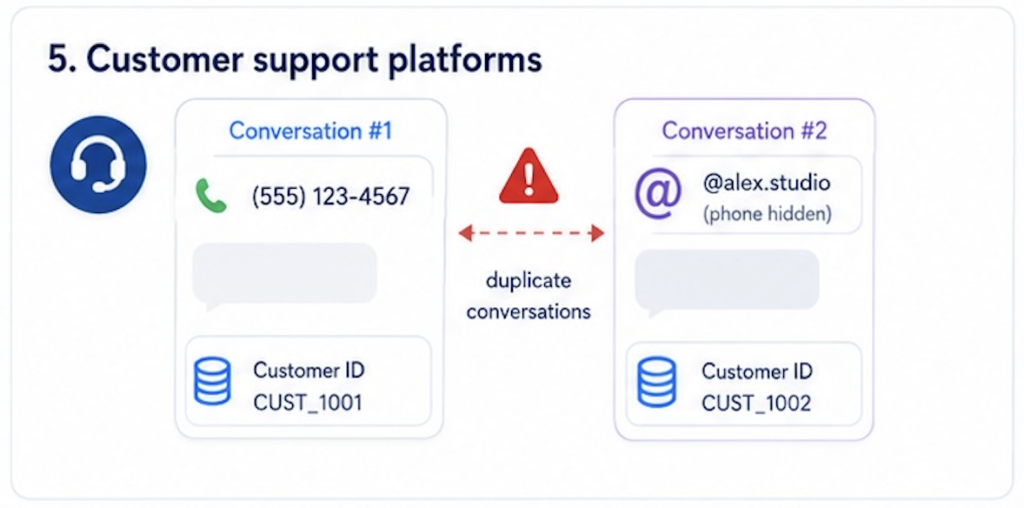
Your support agent may see your existing customer as a new one if it’s not updated to work with WhatsApp Usernames.
Many WhatsApp customer support platforms use the phone number to decide whether an incoming message belongs to an existing customer or a new conversation. If a user arrives with only a BSUID, an older system may open a second conversation instead.
Customers contacting a business through both their username and phone number can appear as two conversations until the identities are matched.
6. Integrations, Webhooks, and custom APIs

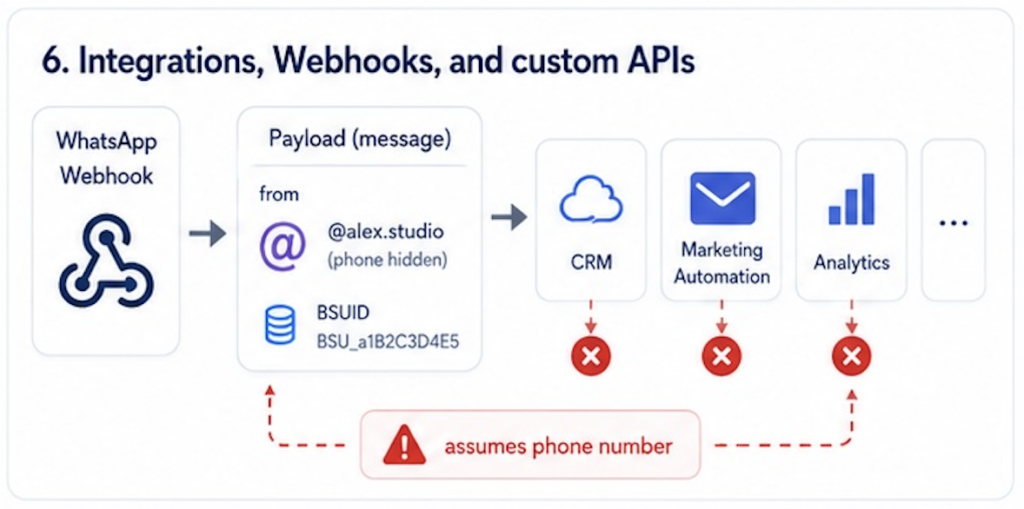
Many integrations take WhatsApp’s “from” or “to” value and assume it will always contain a phone number. With username users, however, that field can contain a BSUID instead. As a result, even if WhatsApp still works, the automation connected to WhatsApp may stop working.
Use Privyr to keep running your WhatsApp campaigns smoothly and convert more customers faster

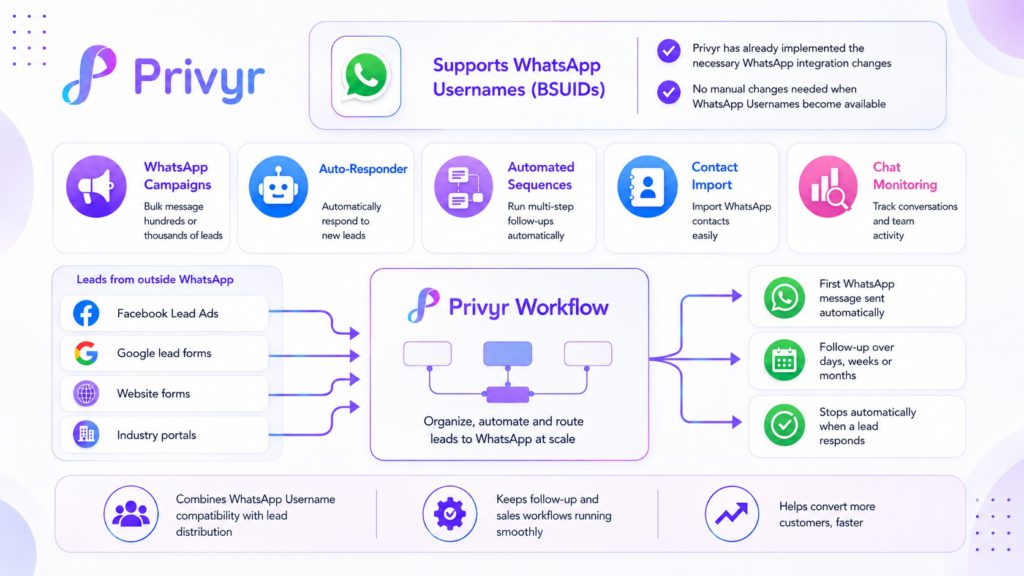
Privyr has already implemented the necessary changes to its WhatsApp integrations for the username rollout. Privyr users won’t need to make any manual change when WhatsApp Usernames become available.
Privyr’s WhatsApp automation toolkit includes:
- WhatsApp Campaigns for bulk messaging,
- a WhatsApp Auto-Responder that can automatically respond to new leads,
- Automated WhatsApp Sequences for multi-step follow-ups,
- WhatsApp Contact Import, and
- WhatsApp Chat Monitoring.
Privyr’s WhatsApp Campaigns let you send messages to hundreds or thousands of leads using your connected WhatsApp Business number, while Automated Sequences can continue following up over days, weeks or months and stop automatically when a lead responds.
Its Automated WhatsApp Sequences can be super useful for leads originating outside WhatsApp. For example, someone submits a Facebook Lead Ad, Google lead form, website form or industry portal, and Privyr can automatically send your first WhatsApp message to the lead and manage subsequent follow-ups through automated sequences.
Privyr combines WhatsApp Username compatibility with lead distribution, follow-up and sales workflow around all your WhatsApp conversations.
Final words
The biggest advantage of having a sales or marketing platform that supports WhatsApp Usernames is continuity.
A platform that doesn’t support Usernames may still let you talk to a username user. But a platform with proper BSUID support can help you recognise your customers, remember them, manage them, automate follow-ups and reconnect future conversations without making the user’s phone number the centre of the entire process.
This is important because WhatsApp users will soon be able to communicate on WhatsApp without needing to provide their phone numbers.
If you mostly generate leads and sell through WhatsApp, having this continuity is the real advantage of using a sales and marketing platform that is ready for WhatsApp Usernames.
Try Privyr for smoother and faster WhatsApp lead management today!
Frequently Asked Questions
A Business-Scoped User ID, or BSUID, is an identifier Meta creates for a WhatsApp user for particular businesses. It’s unique to each business and lets them recognise and message that user even when their telephone number isn’t available and/or their WhatsApp username has changed.
No. Phone numbers still exist and remain part of WhatsApp account registration. Usernames allow people to connect without automatically revealing their phone numbers.
Sometimes. If a customer has previously interacted with your business using their phone number, and your CRM has already stored both their phone number and BSUID, it may be able to match future username-based interactions to the same customer.
If the customer chooses not to share their phone number, your business may only receive their BSUID instead.
However, WhatsApp also gives businesses a way to request a customer’s phone number when it is needed.
Yes, you can send WhatsApp Campaigns to users without phone numbers on platforms that support BSUID-based campaign messaging.
As of August 2026, platforms like Privyr, Salesforce, Freshsales Suite, SleekFlow support WhatsApp Usernames. Twilio also provides BSUID support at API or communications-infrastructure level.
Not necessarily. If your platform has updated its integration to support BSUIDs, it may continue working without changes. When custom software or older integrations assume that every incoming WhatsApp contact must contain a normal phone number, there may be problems.
Yes. WhatsApp supports requesting contact information during eligible conversations.
Not yet. WhatsApp says usernames are being introduced gradually and availability can differ by country.
WhatsApp Usernames and BSUID support are closely related, but the terms mean different things. The username is what the customer sees and shares, while the BSUID is what the business platform uses behind the scenes to identify that customer. BSUID allows the software to maintain the customer’s identity and continue messaging when their phone number isn’t provided.