Have you ever asked how many of your leads go cold before your sales team even contacts them? If not, there’s a good chance you’re trying to fix the wrong part of your lead conversion problem.
For many businesses, the biggest leak in their pipeline is not poor targeting, weak creatives, bad lead quality, or lack of sales training.
It is delay! Every minute between lead capture and first contact reduces your chances of converting a lead.
At Privyr, we call this Death-by-Delay: the silent loss of sales opportunities caused by slow, inconsistent lead response. But how do you fix a process that feels important yet drains your time?
Well, you’re in the right place.
This post will discuss one of the most overlooked conversion problems in sales and how to fix it within hours (not days or weeks).
Speed is the real qualification layer
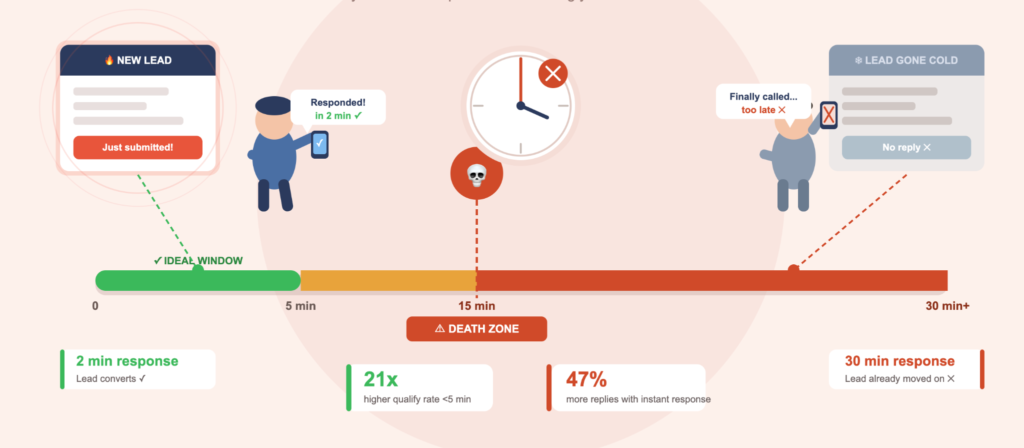
Think of this: If your team responds while the prospect is still interested, you have an improved chance of converting the lead. If your team takes too long to respond, every other qualification step becomes harder.
According to a MIT Lead Response Study, the odds of qualifying a lead drop 21 times when response time moves from 5 minutes to 30 minutes. The same study also found that the odds of actually receiving a response are dramatically higher inside the first few minutes.
Here are some more research-backed realities:
- 78% of buyers go with the first responder
- Responding within 5 minutes increases conversions by 21x
- About 30% of leads never get followed up at all
- 82% of leads expect a response within 10 minutes
- Sales reps spend only about 34% of their time actually selling
A lead that receives a fast response feels acknowledged. A lead that waits feels ignored. And in competitive industries, ignored prospects rarely wait patiently. They just keep looking for someone who will contact them fast.
Speed-to-lead is an operational issue not a tactical one
Most lead response delays are not caused by inefficiency. They are caused by a complicated manual sales process that might look reasonable on the surface.
For instance, activities like reviewing incoming leads before assigning them, making sure premium leads go to experienced reps, carefully checking and routing regional leads, and checking lead quality before passing it to the sales rep sounds responsible. But when these decisions happen manually, things slow down and leads go cold.
How things can fall apart and how to solve them in each step
Step 1. You manage leads on spreadsheets
Managing leads on spreadsheets means going through a long, tedious process just to retrieve leads before even assigning them to your sales reps. A lead lands in, you export it, then sort it, filter it, check the details and finally assign it to the right rep.
By the time the rep sees the lead, the buyer’s attention has already moved elsewhere.
While spreadsheets can be useful for reporting, they are terrible as the first stop for hot leads.
💡How to fix this:
Capture all leads in one place
If your leads come from different sources like Facebook Lead Ads, Google Ads, website forms, landing pages, WhatsApp, the first step you want to commit is centralise lead capture so every lead enters a trackable workflow.
Step 2. You manually assign leads
When your lead distribution happens manually through screenshots, forwarded emails, copy-pasted messages, or group chats, leads can get duplicated and missed. Additionally, managers lose visibility as reps respond at different times. Worse, you can’t track follow ups or know if the leads are even contacted.
How to fix this:
💡Automate lead assignment
If you do not want your hot leads to wait for manual sorting, create clear rules for assignment based on location, product or service, language, source, availability, and round-robin rotation. Then automate lead distribution based on those rules. This way, you do not need to spend time going through your “quality-control” steps before assigning leads. For instance, if you’re handling inbound phone inquiries, you can use AI IVR to automatically route callers based on language, department, or intent, ensuring qualified leads reach the right sales representative without unnecessary delays.
If you rely heavily on demos, consider using dedicated demo workflow platforms such as LevelUp Demo. These platforms automatically capture inbound demo requests, enrich leads with AI, route them to the right team members, and help sales teams respond faster to high-intent prospects.
Step 3. The first touch is delayed
Delayed lead assignment creates a bottleneck. Reps receive leads late and then further deprioritise them against their current pipeline, adding more cold leads and missed opportunities.
💡How to fix this:
Make first outreach effortless
Sales reps lose a substantial amount of time when they have to understand the source, write a message, find the lead’s details, and finally decide how to approach. Give them ready-to-use templates customised for each campaign.
Speed matters, but so does who’s on the other end of the conversation. Before you blame your follow-up process, it’s worth making sure you screen for sales aptitude when building the team, since even fast responses won’t convert if reps lack the persuasion and discovery skills to close.
The faster a rep can personalise and send the message, the less likely the lead goes cold.
Step 4. There’s no visibility on execution
You only discover missed follow-ups after the damage is done. By then, the lead has gone cold, the rep has forgotten the context, and your marketing strategy is blamed for bad lead quality.
Without visibility into response time, ownership, first-touch status, and follow-up attempts, you are managing leads by assumption.
Assumptions can be expensive.
💡How to fix this:
Track speed-to-lead
You cannot improve what you do not measure. Therefore, track metrics like first response time, percentage of leads contacted under 5 minutes, percentage of leads contacted under 15 minutes, leads never contacted, response time by source, response time by rep etc.
This turns your outreach from a general sales issue into a measurable revenue lever.
Bonus tip: Maintain strict lead response discipline
Speed-to-lead can’t be fixed by telling reps to move faster or improving ad elements hoping to attract “better quality” leads. It is fixed by removing friction from your lead management system.
Once you’ve automated repetitive tasks and streamlined your steps, create rules around the recommended time to outreach new leads. If a lead is not contacted within a set time, the system should escalate it.
For example:
After 5 minutes: remind the rep.
After 10 minutes: notify the manager.
After 15 minutes: reassign to another available rep.
After 30 minutes: trigger a recovery sequence.
This protects leads from disappearing into individual queues.
The goal is to reduce the time between lead capture and first conversation to under five minutes, the window when buyer intent is still strongest. It’s only possible when lead assignment is no longer dependent on manual decisions and reps can respond the moment a lead comes in, without operational bottlenecks slowing the process down.
What a good lead response looks like
A healthy lead response system feels organised and almost boring. Here’s how a good lead management process looks like
- A lead comes in.
- The lead is captured instantly.
- The lead is assigned automatically.
- The rep is notified immediately.
- The rep sees the lead source, context, and message history.
- The first response goes out within minutes.
- Managers can see whether follow-up happened.
- Uncontacted leads escalate
How Privyr helps you fix death-by-delay instantly
Privyr isn’t just another CRM layer built for dashboards and presentations. It’s designed to eliminate the delay between a lead being generated and a lead being contacted.
Here’s what Privyr delivers against a manual sales system:
| Stage | Without a System | With Privyr |
| Lead capture | Lead submits a form while interest is high. | Lead submits a form while interest is high. |
| Lead status | Lead sits in a queue and starts going cold. | Lead is instantly captured and imported. |
| Assignment | The manager manually reviews and assigns the lead later in the day. | Lead is automatically assigned in seconds based on predefined rules. |
| Rep notification | Rep receives the lead late, often through copy-paste, screenshots, or incomplete details. | Rep gets the full lead details on their phone immediately. |
| First contact | First contact happens hours later. By then, the lead may have moved on. | First contact can happen within seconds or minutes, while intent is still fresh. |
| Outcome | Higher chance of ghosting, missed follow-ups, and wasted ad spend. | Faster conversations, better response rates, and fewer leads lost to delay. |
Additionally Privyr also allows you to track all your sales metrics, including individual sales rep performance and real time lead follow up. With live visibility into your sales pipeline and team activities, you can quickly identify bottlenecks, address issues instantly, and keep your sales process running smoothly.
The result is fewer leads going cold, faster conversations, and significantly less revenue lost to delay within days, not weeks.
Privyr integrates with lead sources effortlessly, allowing you to instantly sync leads from Meta, Google, website forms, and all the other major lead sources and you don’t need to worry about the learning curve as it’s almost non-existent.
All you need to do is create an account on Privyr and connect your lead sources and communication channels.
Try Privyr today and boost your conversion rate by up to 300%