Getting a response from a lead on WhatsApp is easy. Turning that conversation into a booked call, and ultimately a closed deal, is where most sales teams struggle.
Unlike phone calls or meetings, WhatsApp conversations happen in a low-commitment environment. Leads are distracted, comparing options, and can disappear at any moment. The idea is to not push harder but rather guide your leads through a series of small commitments that naturally lead to a sales call.
This guide will explain how to navigate text-based sales conversations effectively, especially when the selling process eventually requires a phone call, Zoom meeting, or in-person appointment.
Why “Book a Call” often fails on WhatsApp
Many sales teams are trained to move too quickly on WhatsApp. The moment a lead responds, they send a calendar link. But at that stage, the prospect hasn’t yet decided whether a call is worth their time or energy.
A calendar link is not a magic closing tool. In fact, sending one too early can create friction. Suddenly, the prospect has to make several decisions at once: Do I trust this person? Is this worth my time? Do I really need a call? If you haven’t built enough trust or demonstrated enough value, the easiest response is no response at all.
The goal is to earn trust first and guide the prospect through a series of small commitments. When the call is finally suggested, it should feel like the natural next step, not a sales tactic.
The psychology of WhatsApp sales
WhatsApp sales has its own rules.
Your leads can read your message and never respond, reply hours later, forget what they originally asked, misread your tone, feel pressured by a lengthy message, or simply lose interest before you’ve had a chance to explain your offer.
The confusing thing is that some of these leads are just bad leads but many can be quality leads. Your first job is to identify the patterns of quality leads.
Secondly, in text-based sales, you are not just managing the conversation. You are managing the prospect’s attention. And you should know that the lead’s attention is fragile as every message either increases momentum or kills it.
Here are five psychological realities of text-based sales:
1. The buyer is in a low-commitment environment
Leads usually do not feel the same commitment in a WhatsApp conversation as they would feel after booking a call. Messaging is easy, casual, and has a low social cost.
You may get excited when a lead replies, but they can disappear fast. A reply does not always mean buying intent. Sometimes it only means curiosity. Your job is to turn curiosity into commitment, not fast but gradually.
2 The buyer is sensitive to pressure
Messaging on WhatsApp feels personal as it’s a space people use with friends, family, and trusted contacts. When you push for sales aggressively in that space, the buyer’s resistance rises fast.
A hard pitch can feel invasive.
This does not mean you should be passive. It means your message should feel conversational, not transactional.
3 The buyer wants speed, but not carelessness
People use WhatsApp for fast, easy communication. But if the commitment is expensive or important, they still need thoughtfulness.
Therefore, you need to balance two things here: speed and depth.
Respond quickly, but don’t sound like a bot. Keep your messages concise, but not so brief that they’re unclear. And remember: being helpful is good, but overwhelming your prospect with too much information isn’t.
4 The buyer needs a reason to leave the chat
One of the biggest mistakes in WhatsApp sales is asking for a call too soon.
When you ask, “Can we schedule a call?” your prospect may think, “Why? I only asked a simple question.”
Instead of pushing for a call, give them a reason for one. The transition should feel natural: “This is easier to explain over a quick call, and it’ll help me give you the best recommendation for your situation.”
The goal is momentum with micro-commitments, not rushing to closing
Momentum means keeping the conversation moving toward the next step without making it feel forced. Instead of overwhelming prospects with information in the name of “lead nurturing,” focus on creating a sequence of small, easy actions.
First, they reply to your message. Then they answer a simple question, share a bit of context, acknowledge their problem, and agree that you might be the right person to solve it. Only then do they see the value of a call, and book one. This is the psychology of micro-commitments.
A micro-commitment is a small action that moves a prospect one step closer to the next stage of the sales process.
In messaging-based sales, you do not want to jump straight from “Thanks for your interest” to “Book a 30-minute consultation here.” That’s too big of a leap. Instead, guide prospects through a series of smaller commitments that naturally lead to the booking.
Here are your micro-commitment steps to guide your leads to a call
Step 1. Permission
Before asking deep questions or sending information, get permission.
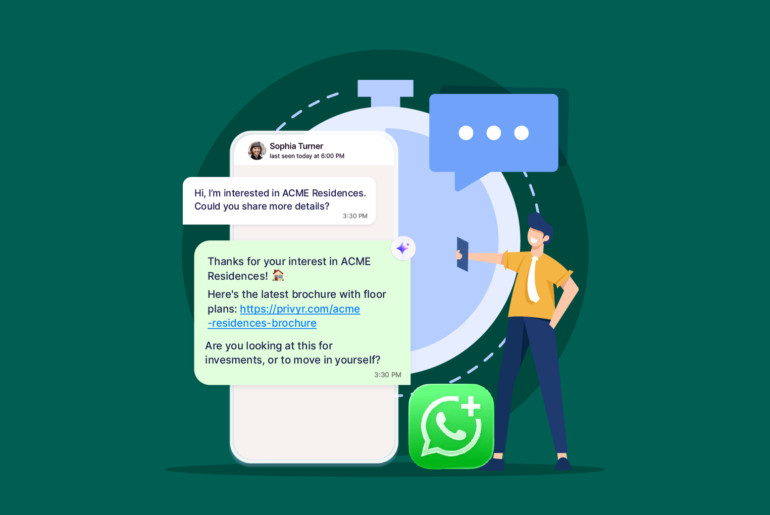
Example: “Hi Jane, Thanks for showing your interest in the policy. Can I ask you two quick questions so I can point you in the right direction?”
This works because your leads feel like they have control. It also makes your next question feel expected instead of intrusive.
Step 2. Context
Understanding the prospect’s context helps you personalise the conversation and make your responses more relevant.
For example:
“Are you looking for this for yourself, your team, or a client?”
This feels natural and conversational rather than intrusive. It’s an easy question to answer, gives you valuable context, and helps the prospect feel guided rather than interrogated.
Step 3. Relevance
Once you’ve understood your lead’s issues and context, it’s time to connect their problem to your solution without pitching too hard.
Example:
“The property exactly meets your requirements. It’s new, located in a good neighbourhood, and fairly priced compared to similar properties in the area.”
Now your lead can see why your offer might be relevant.
Step 4. Confirmation
Now is the time to ask your lead to confirm their problem or priority.
Example:
“Would it be fair to say your biggest priority is the best neighbourhood?”
If the lead says “yes,” they are committing to the importance of the problem.
Step 5. Transition
At this stage, a call now feels useful, not random. It’s time to explain to the lead why a call or a visit is the best next step.
You might say the conversation has reached a point where a quick call or visit would be more effective instead of going back-and-forth over text. Because your lead already sees the value, agreeing to the call feels natural.
Common mistakes in text-based sales
Mistake 1: Pitching too soon
If the lead hasn’t shared enough information and context yet, your pitch will feel generic. Instead, ask a small diagnostic question first.
Mistake 2: Asking for a call without creating value
“Can we jump on a call?” is a big ask when the prospect does not yet see why the call matters. You should always give the call a specific purpose.
Mistake 3: Sending too much information
WhatsApp is not for sharing long messages. For users, they feel like going through a day’s work. Therefore, only send texts long enough to move the conversation forward.
Mistake 4: Being too formal
Messaging apps are conversational spaces. Sound human.
Instead of:
“Thank you for your inquiry. We would be delighted to assist you.”
Try:
“Thanks for reaching out. Happy to help!”
Mistake 5: Being too casual
Sounding human doesn’t mean being too casual. That would be unprofessional and careless.
Avoid sending messages like the following:
“Heyyy yeah lol we can help”
You still need professionalism, clarity, and confidence.
Mistake 6: Following up with no purpose
Every follow-up should either add value, ask a clear question, or close the loop.
Mistake 7: Treating all leads equally
Some leads are curious. Some are urgent. Some are skeptical. Some are ready. Adapt your messaging accordingly.
How to use automation without losing the human touch
WhatsApp moves fast, and leads expect a quick response. Navigating the process of receiving leads from your sources, distributing them to the team members, and reaching out fast manually via WhatsApp is unsustainable. This is where you must use automation to stay in the competition.
Automation helps you instantly acknowledge new inquiries, automatically follow up multiple times, route leads to the right salesperson, and reconnect with leads that have gone quiet. You can even integrate a voice AI platform to handle inbound phone conversations, qualify leads, and seamlessly hand off high-intent prospects to the right salesperson. That being said, automation should never make the conversation feel like it’s coming from a bot.
On WhatsApp, people expect a personal and conversational experience. The best automated messages are timely, relevant, and easy to respond to, while the worst ones feel generic and scripted.
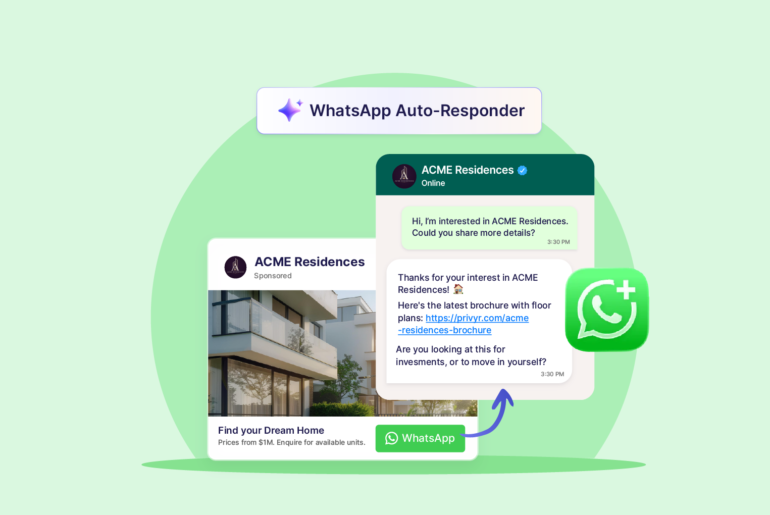
Privyr can make a huge difference here. Using WhatsApp Sequences, which are designed around micro-commitments, you can instantly and automatically reach out to new leads and follow up with them multiple times, from your own WhatsApp Business number. And if you have a team, you can also set up rules to automatically route new leads to the right team members. As a result, every lead receives a fast response, consistent follow-ups, and a conversation that gradually builds trust rather than rushing toward a sale.
Sales teams can reduce their response times, prevent leads from slipping through the cracks, and move more prospects from initial inquiry to booked call.
With Privyr, you can create an automated WhatsApp Sequence of simple, conversational, and personalised messages to move the conversation towards sale.