A WhatsApp lead qualification agent is an AI-powered assistant that handles the early stage sales conversation with your leads and determines whether they are good sales opportunities, filtering qualified leads for sales teams.
Short on time? Here are the key takeaways:
A WhatsApp lead qualification agent automatically identifies which inbound leads are worth your sales team’s attention. Instead of only answering questions like a chatbot, it can collect qualification information, interpret buying intent, update your CRM, and hand over the conversation to sales reps.
- Platforms like Privyr, WATI, respond.io, and SleekFlow offer lead qualification agents. Alternatively, you can also set up your own agent given you have a technical team and don’t mind managing and updating systems frequently.
- Privyr’s lead qualification agent is designed for sales teams that want to keep using their existing WhatsApp Business app while connecting qualification directly to their CRM workflow.
- While choosing an agent, consider how naturally it handles conversations, how well it integrates with your existing WhatsApp workflow, and how efficiently it uses billable service messages.
- From 1 October 2026, Meta service messages sent through the WhatsApp Business Platform come with a cost. Setting up your WhatsApp lead qualification agent for efficient conversations is the new challenge.
- Privyr is one of few platforms that currently absorbs Meta service-message charges for its users.
If you receive an inbound enquiry asking the price of your product or service, would you just send over the price list? Or would you want to know more about the lead’s preferences, budget, how soon they want to buy, or if they have more questions, so you can determine if the lead is worth your team’s time?
If you’re more into the latter, lead qualification is an important part of your sales process. Qualifying leads can be tedious when you receive a lot of enquiries, and your team can’t afford to waste time on queries that are unlikely to lead to a sale. Luckily, you can now set up AI agents to take care of your lead qualification process.
A WhatsApp lead qualification agent helps qualify leads without your team needing to worry about indulging in all starting conversations.
But how to get started?
In this article, we’ll explain everything you need to know about WhatsApp lead qualification agent, how to get started, and how to make the most of it.
What is a WhatsApp lead qualification agent?

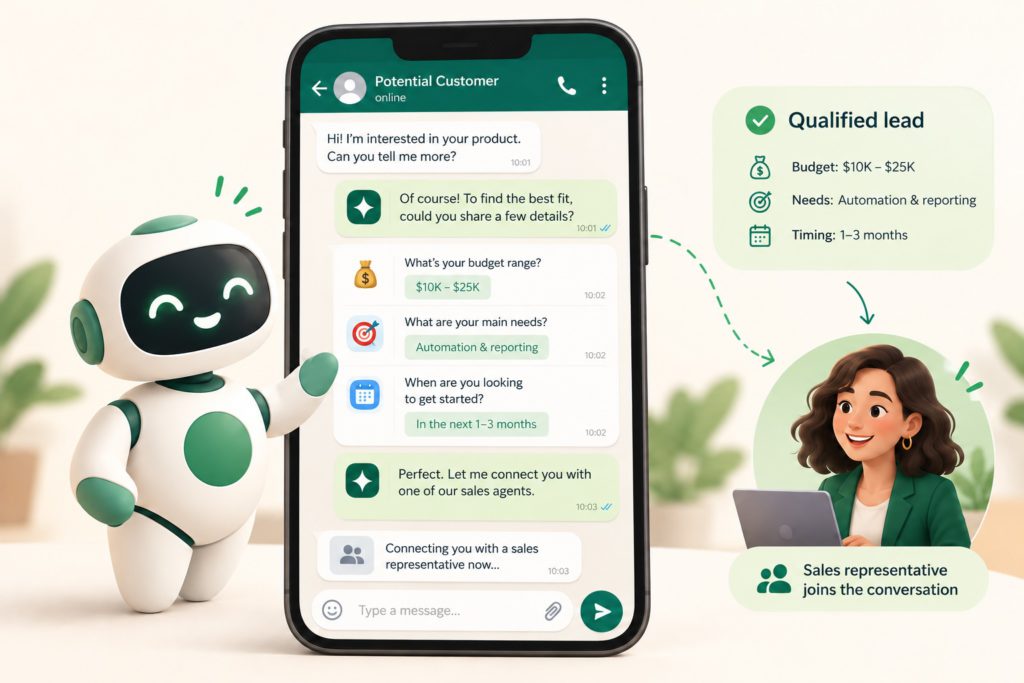
A WhatsApp lead qualification agent helps you determine whether your incoming leads are good sales opportunities by handling a series of initial messages, without your team’s involvement.
Let’s suppose you receive the following enquiry on your WhatsApp:
“Hi, I saw your Marina apartment ad. Can you send me the price?”
If you have a basic WhatsApp autoresponder or a chatbot, it might just respond to the query with the price list.
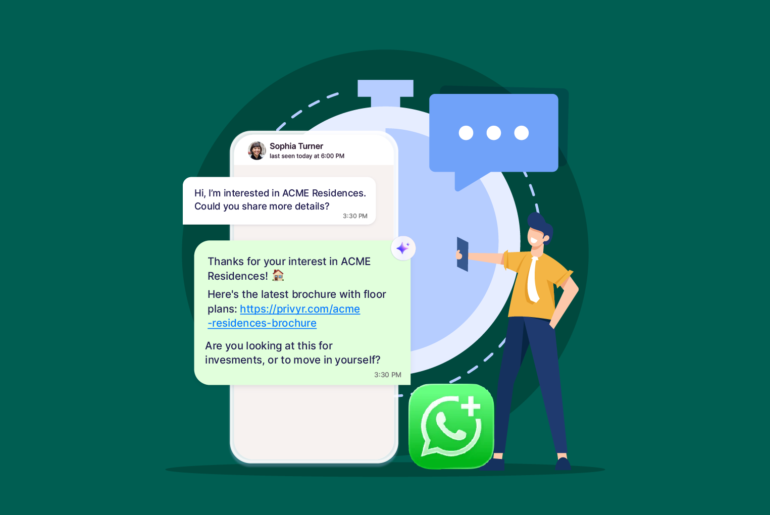
Lead qualification agent will take it further and recognise which property the prospect is talking about, answer the pricing question, then ask follow up questions around whether the lead is looking to buy for investment or for themselves, what is their timeline, if they have any other query, etc. When the prospect replies, the agent can extract several qualification signals from that reply.
By the time your salesperson joins the conversation, they’ll already know the prospect’s budget, purpose, preferred location, timeline, and property preferences. If the lead is just looking for information without a buying intent, the agent ensures salespeople won’t have to invest their time in those leads.
WhatsApp qualification agents turn an unstructured WhatsApp enquiry into useful sales context before you invest human time on the lead.
Traditional chatbots generally operate through predefined branches. But leads rarely answer qualification questions in exactly the format you expect.
For instance, if you ask what’s their budget, you may probably receive an answer similar to the following:
“We haven’t fixed it exactly but probably not more than 80k, unless the financing works.”
While chatbots can struggle responding to such answers correctly, a qualification agent can extract the approximate budget, retain the uncertainty around it and decide what question to ask next based on the reply.
The best lead qualification agents use AI to process the language but work within with business rules to make qualifying decisions.
Why and when do you need a WhatsApp lead qualification agent?


When you start receiving a lot of enquiries, many are repetitive, low-intent, or missing the basic information your salespeople need before deciding whether to follow up. You don’t want your reps investing their time attending every lead when they need to focus on important sales conversations down the funnel. This is where a WhatsApp lead qualification agent can help.
A WhatsApp lead qualification agent can be especially useful when your team receives a high volume of inbound enquiries, and manually checking every lead immediately isn’t practically possible.
Look for a WhatsApp lead qualification agent if:
- you receive a high volume of WhatsApp enquiries,
- your team repeatedly asks the same qualification questions,
- leads often arrive outside working hours,
- response speed impacts your conversion rate,
- you need to collect some important information before assigning leads to the right rep,
- your salespeople are spending too much time qualifying leads that are unlikely to buy.
Lead qualification agents don’t just ensure faster replies, but also handle repetitive early-stage qualification, ensuring your reps spend more time on qualified leads.
When you probably don’t need a WhatsApp lead qualification agent
A lead qualification agent may not be useful if your enquiry volume is low and/or every lead deserves personal attention.
You do not need a lead qualification agent when:
- you only receive a small number of enquiries,
- most incoming leads are already qualified,
- your team doesn’t need to invest a lot of time asking qualification questions,
- your qualification process only involves one or two simple questions,
- or your team can comfortably respond to new leads fast,
In these cases, a simple WhatsApp auto-reply or manual follow-up may be more efficient. As a business, you want to automate a genuine bottleneck in your sales process and not introduce AI where your existing process already works well.
How does a WhatsApp lead qualification agent work

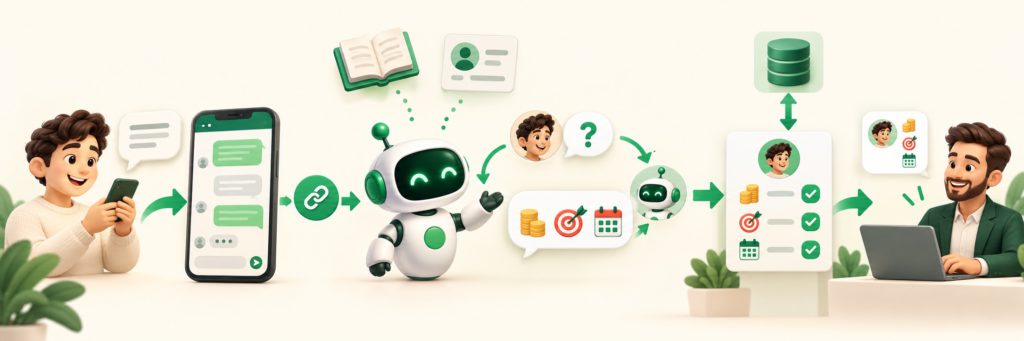
WhatsApp lead qualification agents are usually provided by a CRM or a WhatsApp sales platform. If you use platforms like Privyr, you can simply activate the agent and set up the knowledge base.
There are usually many layers behind an agentic WhatsApp conversation. The information passes through these layers to send the correct message and record the lead’s intent accurately.
When these pieces are properly connected, the workflow looks like this:
A prospect messages you on WhatsApp.
⬇️
WhatsApp integration detects the message and identifies the source.
⬇️
The qualification agent is triggered and loads lead information.
⬇️
The agent receives the first message and compares what it already knows.
⬇️
It then asks for information set for qualification rules.
⬇️
When the prospect responds, the AI extracts useful information from the answer and updates the qualification state.
⬇️
If the response contains several pieces of information, all of them are captured at once.
⬇️
The process repeats until the agent has enough evidence to decide the next step, such as handing over the conversation to reps.
Where to get started with WhatsApp qualification agents?

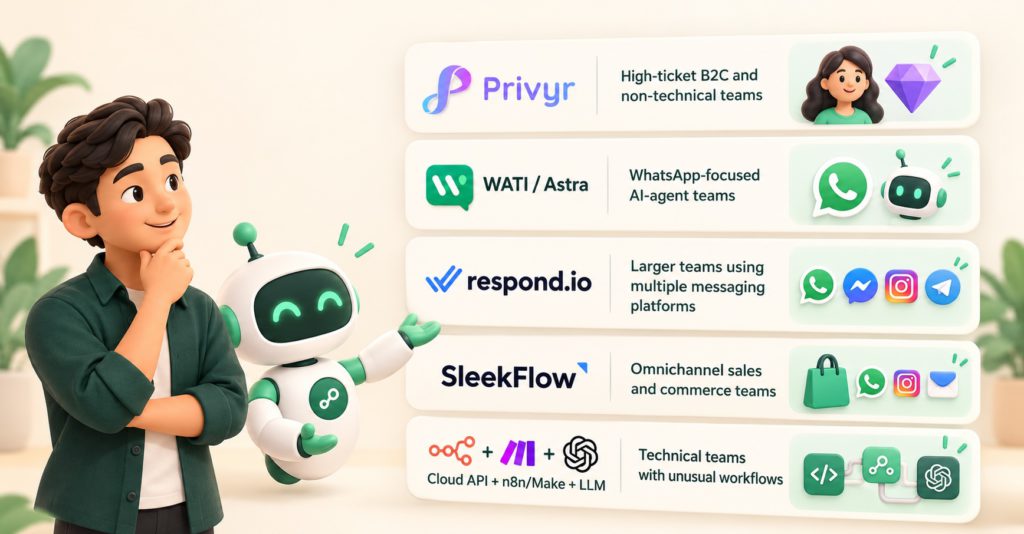
Setting up the right WhatsApp lead qualification agent depends on how your sales process works and which parts of that process matter most to your team. There is no single setup that works for every business.
Your agent should be built around where you already qualify leads.
Think about what information your team needs before taking over a conversation, which criteria are essential for qualification, which signals indicate strong buying intent, and when the agent should stop asking questions.
The table below explains practical starting points:
| Option | Best starting point for |
| Privyr | High-ticket B2C teams selling through WhatsApp, non-technical teams |
| WATI / Astra | WhatsApp-heavy teams |
| respond.io | Larger teams managing multiple messaging platforms |
| SleekFlow | Omnichannel sales and commerce teams |
| Custom Cloud API + n8n/Make + LLM | Technical teams with unusual workflows |
Privyr: For high ticket B2C WhatsApp sales teams

If your business already lives in the WhatsApp Business app and you want automation to take over the repetitive first stage of sales, Privyr can be the most interesting place to start.
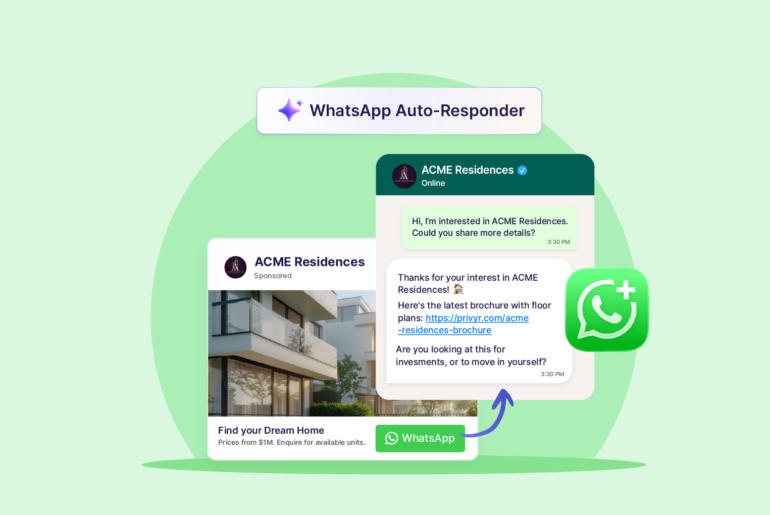
Privyr’s WhatsApp AI Lead Qualification Agent sits inside its Auto-Responder. You first define what information it needs to collect and how it should engage the lead. Then set up the AI agent to handle the conversation naturally and qualify leads.
Privyr also allows different automations to trigger depending on the enquiry, product, Click-to-WhatsApp ad, QR code or other conditions.
Privyr’s approach is particularly relevant to high-ticket B2C sales because of three reasons:
The first is Coexistence. This allows you to connect your existing WhatsApp Business number rather than moving your entire sales process into a completely different inbox. You can keep your existing number, contacts, chats and groups, and continue using WhatsApp Business on your phone or computer while the agent runs in the background.
Secondly, Privyr’s qualification agent works as part of your existing CRM and lead management workflow, rather than as a separate chatbot. This means, you’re not getting a standalone chatbot that is disconnected from your sales process. The information the agent collects becomes part of the same lead record your sales team uses to follow up and manage the opportunity.
The third is cost, particularly after 1 October 2026, as Meta has started charging service messages. Privyr is currently absorbing Meta’s service-message costs, meaning users will not be charged for sending API messages through Privyr.
Here’s how to easily set up a WhatsApp lead qualification agent on Privyr:
- Open Privyr Web.
- Go to Automations.
- Select WhatsApp.
- Open Inbound Inquiry Auto-Responder.
- Connect your existing WhatsApp Business number.
- Choose the type of enquiry that should trigger the rule.
- Define the response.
- Create additional rules for your other common enquiries.
- Set qualification criteria and rules.
- Test the enquiry types.
- Activate your rules.
WATI/Astra: For detailed AI qualification controls
WATI’s Astra is a dedicated AI-agent platform that provides lead qualification functionality based on BANT criteria or custom criteria.
Astra qualification agent can work great if you want a more formal scoring model or if you already run your sales conversations through WATI. Astra can collect answers, evaluate criteria and turn the result into downstream actions rather than just talking to the prospect.
Keep in mind that from 1 October 2026, WATI confirms that free-form messages sent through Astra, WATI chatbot steps, or by human reps will count as service messages under Meta’s new per-message pricing model. Once the monthly free allowance is used up, you’ll be charged for each service message delivered.
Respond.io: For multichannel teams
Respond.io can support your workflow well if qualification is a part of a larger operation. Its AI Agent can collect qualification data, update contact fields and lifecycle stages, assign qualified conversations to reps or teams, and create handover summaries.
You can also instruct your agent to ask only missing questions, apply explicit qualification rules and update lifecycle status automatically. It supports larger teams with multiple members sharing WhatsApp, Instagram, and other messaging channels, especially when you need more complex routing, lead assignment, and centralised reporting.
From 1 October, 2026, respond.io will pass Meta’s WhatsApp service message charges through to its users.
SleekFlow: For larger omnichannel and commerce workflows
SleekFlow’s agents can score leads based on defined criteria, hand conversations over to humans based on exit conditions, generate internal summaries, and then trigger downstream actions such as routing a high-intent lead or syncing information to HubSpot or Salesforce.
SleekFlow provides appealing qualification agents for teams whose WhatsApp qualification process is connected to a broader eCommerce, contact-centre, or omnichannel operation.
Building your own agent: For maximum control
You can also build a WhatsApp lead qualification agent yourself. A typical custom stack may include:
- Meta’sWhatsApp Cloud API for messaging,
- a webhook for incoming events,
- an orchestration layer such as n8n or Make, an LLM,
- a database for conversation memory,
- a CRM for the lead record,
- and APIs for calendars or other business actions.
Building a custom agent means you’ll need to take care of many things yourself, including API authentication, retries, duplicate web-hooks, message status events, session state, failed tool calls, rate limits, CRM conflicts, template approval, prompt changes, knowledge-base updates, human takeover, logging, privacy, model changes and WhatsApp policy changes.
If you’re a B2C business looking to improve your sales process with agents, building and maintaining all of that to automate four qualification questions may not make sense.
Things to consider before setting up your WhatsApp lead qualification agent
If you’re setting up a WhatsApp lead qualification agent, your main goal is to automatically identify leads that are genuinely worth your team’s attention.
That means you’re not simply setting up a chatbot to answer inbound enquiries. You’re creating an intelligent agent that can engage new leads, gather relevant information, and separate promising leads from low-intent or unqualified enquiries.
Done well, this will allow your sales team to allocate more time to deal with people who are more likely to become customers instead of manually qualifying every incoming lead.
A few things you’ll want to consider before setting up your agent include:
Qualification agents should not behave like questionnaires

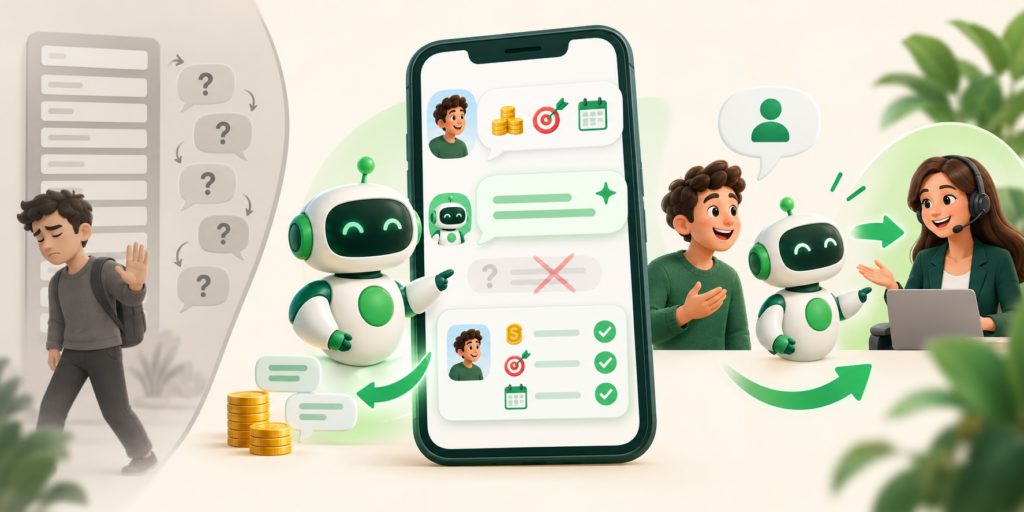
When your qualification agent takes an existing web form and turns every field into a chatbot question, your leads may feel like filling in a form one message at a time. It may cause them to lose interest and never respond again.
Good qualification agents answer and qualify simultaneously. If the lead message already contains information the agent planned to ask later, it captures it and skips the redundant question.
More importantly, if the leads clearly want to speak to somebody, good agents do not force them through the remaining qualification script before handing them over.
This is more important now as WhatsApp service messages are billed. Every unnecessary message is potentially another cost.
Don’t let agents overly rely on BANT criteria
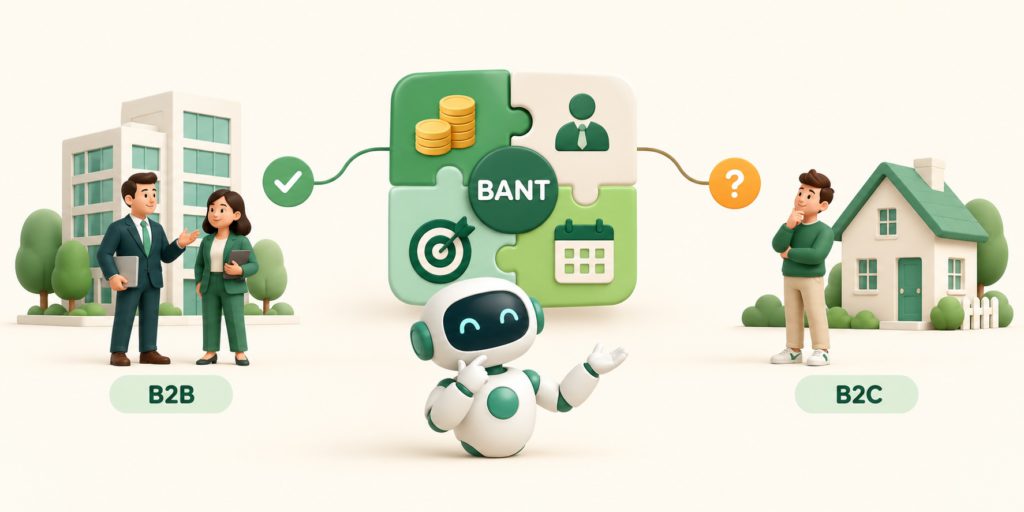
Many AI lead qualification agents providers such as WATI recommend BANT criteria (Budget, Authority, Need and Timeline) as default framework to qualify leads. It can work well for B2B sales processes. But it can provide poor results for B2C.
For example, If you are an estate agent, asking whether the prospect has “authority” makes little sense. You probably care more about their budget, preferred location, property type, buying purpose, financing and timeline.
Similarly, If you run an HVAC or home-services business, your main qualifying criteria might be the service required, urgency, property type and preferred appointment time.
For high-ticket B2C sales processes, you want your qualification agent to reflect the questions your sales team needs answered before deciding what to do next.
Use hard qualification rules and soft qualification scores separately

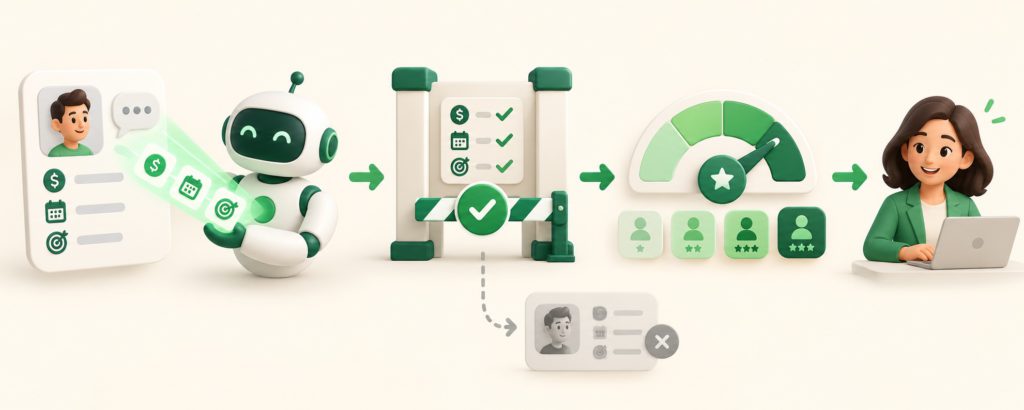
Lead qualification shouldn’t be as simple as prompting your agent to “decide whether a lead is hot based on the conversation”.
Instead, you want your agent to follow a clear set of qualification rules based on your sales knowledge and experience. These rules should define what information matters, which criteria are essential, how different signals should be interpreted, and what combination of factors indicates buying intent.
Hard qualification rules are conditions that your leads must meet before moving further. For instance, you may only serve certain postcodes, a property costs at least £400,000, or a service is only available to commercial customers.
If a lead does not meet one of these essential conditions, adding more qualification layers doesn’t make sense.
Soft qualification signals tell you how attractive a lead is once they meet basic criteria. You might weigh need, budget, timeline, and purchasing intent to decide whether a lead is classified as lower or higher priority.
For the best qualification outcomes, the agent should normally extract evidence, while your rules calculate the result.
For example, the agent might output the following structured data:
budget_band = £500k–£750k
purpose = investment
timeline = 0–3 months
financing = mortgage
viewing_intent = yes
missing_information = none
Your qualification engine can now apply your predefined rules to the data to determine the qualification level of the lead.
The agent shouldn’t invent missing qualification data

Unknown is a perfectly valid value.
Suppose you have set three hard qualification rules: budget, location, and timeline. When a lead provides their location and says they want to buy soon, but never mentions a budget, the record should show the budget is unknown.
The agent should not hypothesise the prospect probably has sufficient budget because they sounded enthusiastic. This may seem obvious, but it’s not a lead qualification system you want to trust.
The same principle applies to other important factors like pricing, availability, eligibility and product specifications. If the agent does not have an authorised source for the answer, it should either say it needs to check or hand the conversation over to a human representative.
Conclusion
If you’re a sales-driven B2C business already using WhatsApp Business, you want a simple, stress-free solution that qualifies leads the way your team does. Privyr provides the strongest practical starting proposition for that use case.
You don’t need to turn WhatsApp into a contact centre just to set up a qualification agent. You can easily connect your existing WhatsApp Business account, define what the agent needs to learn about each prospect, let it handle the initial qualification, and keep the information inside the same CRM record.
When a lead is qualified or reaches the point where human involvement matters, you can simply step into the WhatsApp conversation yourself and continue from there.
Frequently asked questions
A WhatsApp lead qualification agent is an agentic system that automatically engages new leads, collects necessary information, and helps determine whether they need your sales team’s assistance based on the qualification criteria you set.
A chatbot mainly responds to enquiries, while a qualification agent also interprets answers, collects sales data, applies qualification rules, and decides the next step.
Lead qualification agent should ask for the information your team needs to qualify a lead, such as budget, requirements, location, urgency, or purchase timeline, depending on your product and sales process.
Yes, but it should follow predefined qualification rules and scoring criteria you set rather than making a judgement based only on the tone of the conversation.
If your team uses WhatsApp for sales, Privyr makes it easy to set up a lead qualification agent to handle growing enquiries, without technical expertise, switching tools, or learning a new platform.