Contents
If you’re seeking flexibility, independence, and performance-based income, real estate is a popular career choice in the US. However, in order to succeed, the role demands commitment in honing your sales, marketing, negotiation, and local market expertise.
If you’re looking to build your career as a real estate professional, we’ll explain everything you need to know about becoming a real estate agent in the US.
The American real estate profession does not require a college degree. But it requires licensing, ongoing education, and good people skills. This article will guide you through a step-by-step process to becoming a real estate agent in the US, along with some tips on best practices.
Who can become a Real Estate Agent in the US?
You can become a real estate agent in the US if you are at least 18 years old, have a high school diploma, good command in English, and are a US citizen or can work legally in the US.
Here are the full requirements:
Age


You must be at least 18 years old in most states to apply for a real estate licence. Some states may require a minimum age of 19 years old.
Education


Most states require at least a high school diploma or GED qualification. You do not need a college degree anywhere in the US to apply for a real estate licence.
Citizenship and immigration status

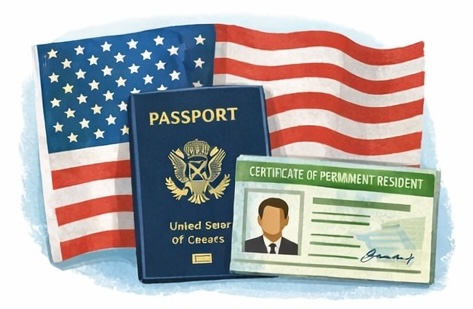
To become a real estate agent in the US, you must be a US citizen or a legal US resident with authorisation to work in the US.
You can’t become a licensed agent if you are on a temporary visa or do not have legal permission to earn commission income. Some states allow non-citizens with valid work authorisation to practice real estate, while others require additional documentation.
Background and criminal record


To become a real estate agent in the US, you must not have serious criminal convictions or past offenses you are unable to explain. If you have multiple offences, there will be a case-by-case review.
You may be disqualified if you have recent or severe felony convictions, especially involving fraud, theft, or financial crimes. Most states require fingerprinting and background checks. A criminal record does not automatically disqualify you, but full disclosure is mandatory.
State residency

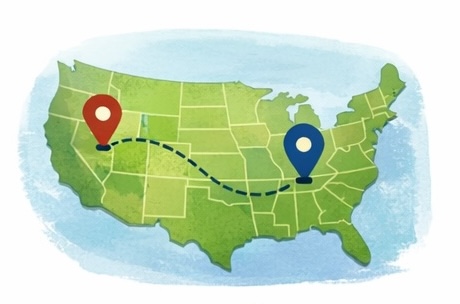
In most states, you do not need to live in the state to be licensed there. That being said, you must meet that state’s education and exam requirements to work as a real estate agent in that state.
Additionally, some states may have residency or business address requirements, while others have reciprocity agreements with other states.
Language and communication


You should be able to read, write, and understand English well enough to pass the licensing exam and handle contracts. If you have bilingual or multilingual skills, it can be a major advantage, especially in diverse markets.
Employment status
You can become an agent if you are employed, unemployed, self-employed, or switching careers. Working full-time or part-time as a real estate agent is allowed in most estates. However, you must be affiliated with a licensed broker, and you’ll typically be classified as an independent contractor, not an employee.
What does an American real estate agent actually do

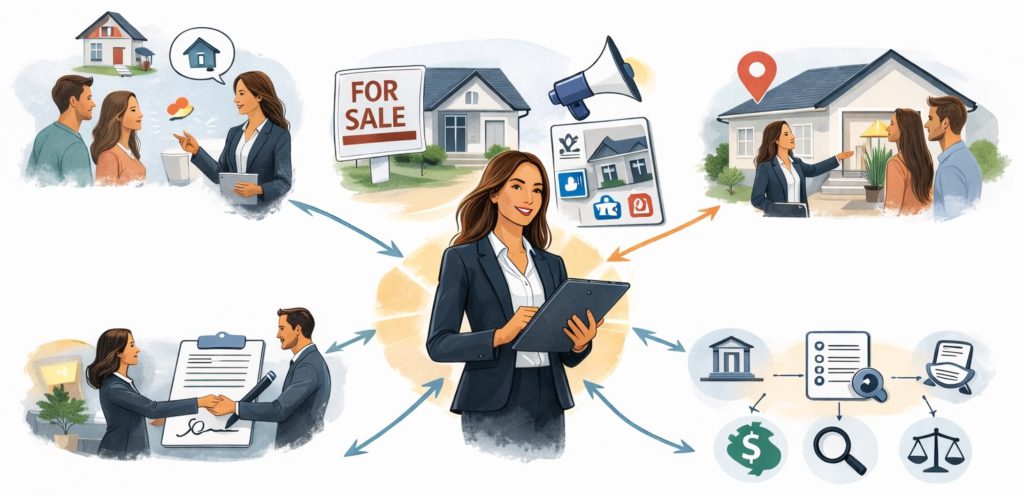
A real estate agent in the US is a licensed professional who represents buyers, sellers, or renters in property transactions. Below is a breakdown of what the role may involve:
- Help clients buy, sell, or rent property
- List properties, market them, and coordinate property viewings
- Negotiates offers and guides clients through contracts
- Coordinates with lenders, inspectors, appraisers, and attorneys
Most real estate agents in the US are paid by commission, rather than a fixed salary. Commission is typically a percentage of the property’s sale price, which is usually split between the buyer’s agent and seller’s agent, the agent, and their brokerage.
As an aspiring real estate agent in the US, income could be irregular, especially in the first year where you are essentially running a small business. Your success depends heavily on networking, follow-ups, and local market expertise.
Step-by-step guide to becoming a real estate agent in the United States
Step 1: Check basic eligibility requirements

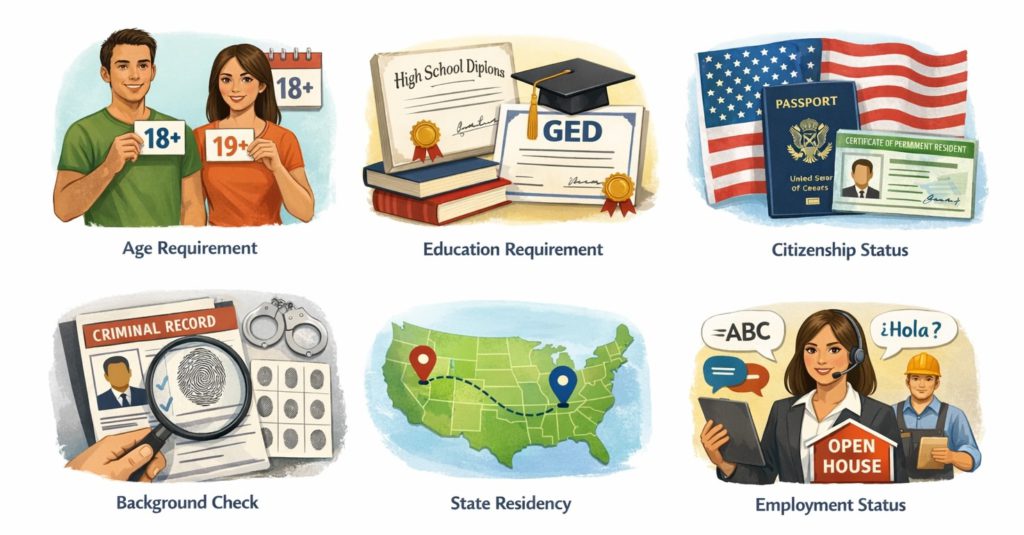
Eligibility requirements vary slightly by state, but generally you must:
- Be at least 18 or 19 years old
- Be a legal US resident or legally allowed to work in the US
- Have a high school diploma or GED
- Have a clean or explainable background
- Felonies may subject to disqualification in some states
- Some states require fingerprinting and background checks before licensing
Step 2: Complete pre-licensing education
Once you’re eligible, fulfill the pre-licensing course hours from a state-approved provider.
Depending on your state, you’ll be required to complete between 40 to 180 hours of coursework. For instance, in California, the pre licensing course is 135 hours, whereas in Texas, it’s 180 hours. Florida and New York, on the other hand, require 63 hours and 77 hours respectively.
Pre-licensing courses typically cover the following topics:
- Real estate principles
- Contracts and agency law
- Property ownership and land use
- Fair housing laws
- Ethics and fiduciary duties
- State-specific real estate laws
Courses can be online (self-paced), in-person, or hybrid, depending on your preferences.
Step 3: Pass the state real estate licensing exam
After completing the real estate course, the next step is to take and pass the state licensing exam.
Exam structure include the following:
- National portion (general real estate principles)
- State portion (local laws and regulations)
- Time-limited multiple-choice questions
Keep in mind that a significant number of applicants fail the exam in their first attempt. Taking exam prep courses and practice tests can help you succeed.
Step 4: Apply for your real estate licence
After passing the real estate licensing exam, it’s time to apply for your licence through your state real estate commission.
This usually includes:
- Licence application
- Exam results
- Proof of education
- Fingerprinting and background check
- Application and licensing fees
The processing time can be a few days to several weeks, depending on your state.
Step 5: Join a brokerage
Your real estate licence allows you to work as a real estate agent in your estate under the supervision of a broker. As a real estate agent, working under a licensed real estate broker is mandatory in the US.
When choosing a brokerage, consider a few things like commission split, training and mentorship programs, lead generation support, brand reputation in your local market, monthly costs, etc.
Step 6: Set up your real estate business
As an American real estate agent, you’re effectively self-employed, even when you’re just starting out. And although you must work under a licensed broker until you become a broker yourself, you’ll still be building and running your own business from day one. Your success as an agent depends on how well you manage your operations and client relationships.
To set up your real estate business, you’ll typically need a separate business bank account, a simple real estate website or landing page, professional email, and a dedicated phone number.
You may also want to plan for ongoing costs. These can include monthly or annual brokerage fees, MLS access fees, and memberships with local, state, or national real estate associations. Also, marketing and advertising expenses, such as fees for online ads and ongoing listing promotions, can add up.
To operate smoothly, you should plan ahead and invest in tools that help simplify your tasks. A CRM can help you manage leads, track follow-ups, and maintain long-term relationships with every lead or client. Having a clear marketing budget for ads, professional photos, and signage ensures you stay visible in a competitive market without overspending.
Step 7: Complete post-licensing and continuing education
In most US states, new agents are required to complete post-licencing education within the first 6 to 12 months after being licensed.
You must also complete continuing education, commonly known as CE, for each license renewal cycle. Renewal periods typically occur every two to four years, depending on the state. Continuing education helps you stay updated with changes in real estate laws, industry standards, fair housing requirements, etc.
In many states, missing CE deadlines can lead to license suspension, late fees, or even the need to reapply for licensure.
How a real estate CRM like Privyr helps agents succeed
If you want to succeed as a real estate agent in the US, you should aim big and take an aggressive approach to find and contact new clients. Responding instantly to every new enquiry and following up multiple times are just some of the things you must do to beat the competition.
To maximise your chances of success, you need a CRM system. Keep in mind, a CRM doesn’t replace hustle, but it multiplies your hard work by making every follow-up count.
If you’re new and want a powerful real estate CRM that doesn’t demand technical expertise to operate and works on any device, such as your phone or laptop, look no further than Privyr.
Privyr helps you effortlessly
- Manage and track all leads in one place
- Ensure consistent follow-ups with automations
- Reduce response time from days to seconds
- Get instant alerts for new leads from any of your sources
- Organise clients by stage
- Improve lead conversion
- Track communication history
- Automate routine tasks
- Improve time management
- Provide visibility into your sales pipeline
- Introduce structure, systems, and repeatable processes.
- Enable scalability
- Support team collaboration
- Track performance and results
Privyr helps you ensure your leads and clients feel remembered, valued, and well-managed.
How to use Privyr as a real estate agent

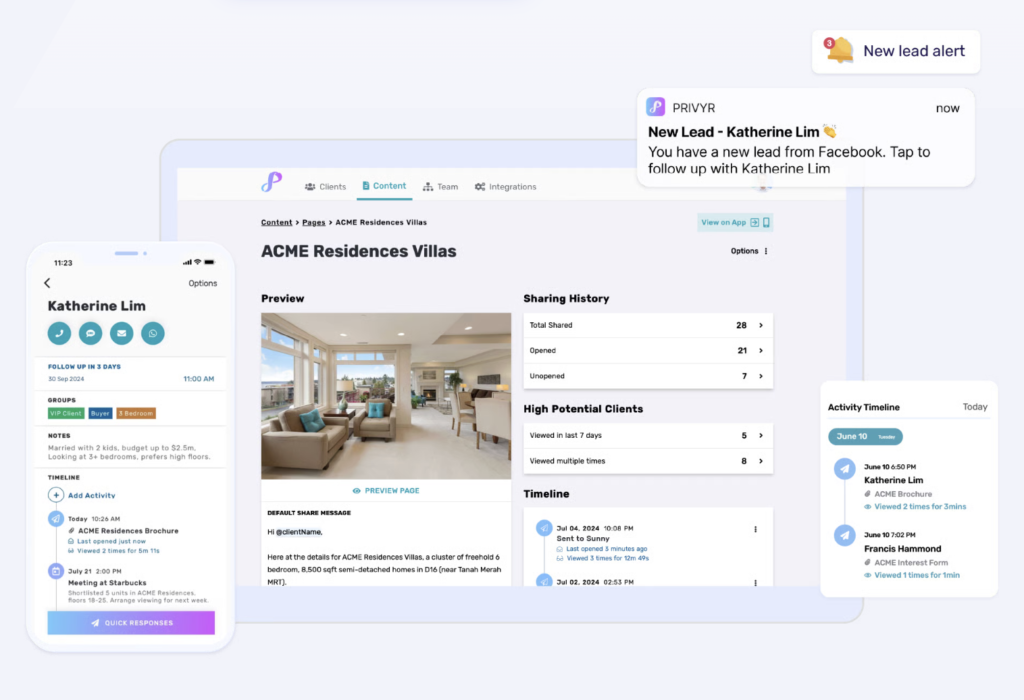
Using Privyr is as simple as using your favourite messaging app. All you need to do is create a Privyr account, download the app on your mobile (or use the web app), and connect it to your real estate lead sources (such as Zillow or Facebook Ads). Once the integration is complete, you can use Privyr to manage all of your leads from a central place, automate follow-ups, and oversee your sales pipeline. Privyr simply helps you contact clients faster and close more deals.
Here’s a step-by-step process:
Step 1: Create your account and download the app
Go to www.privyr.com and create your account. Then, install the Privyr app on your mobile. Privyr is available on both the App Store for iOS devices and Google Play Store for Android devices.
Step 2: Connect Privyr to your lead source
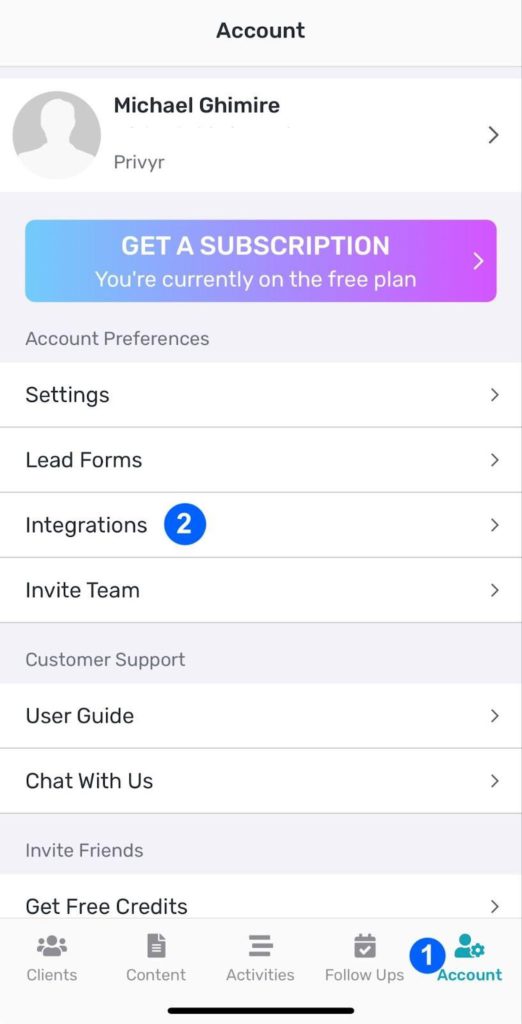
In the app, tap on Account and select Integrations.

Under the Lead Sources tab, you’ll find your lead sources. Tap Configure on the lead source you want to integrate with Privyr. This will redirect you to the lead source page. Click on Continue and follow the instructions. Your Privyr account is now connected with your lead source.

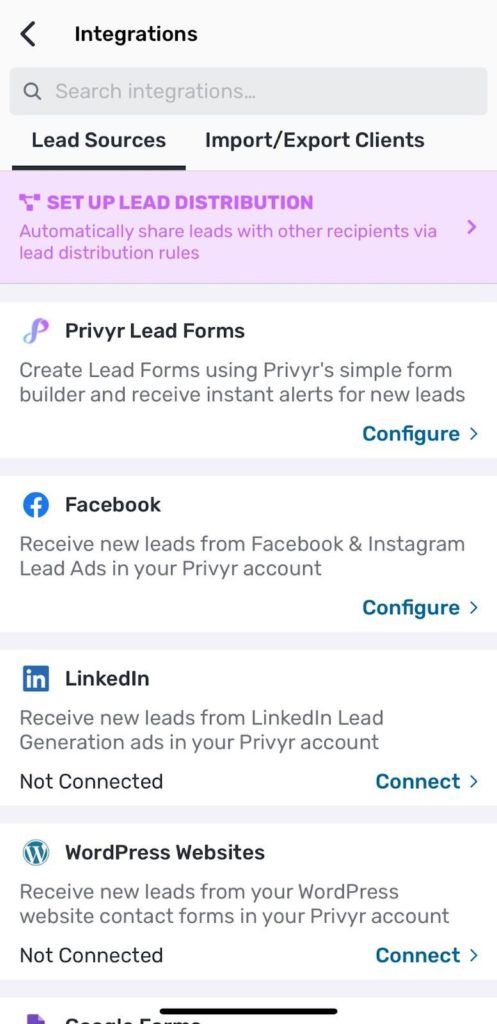
You can connect multiple lead sources to Privyr from the Lead Sources tab. Once successfully connected, your Privyr app is ready to manage your leads and streamline your sales process.
Advancing your career as a real estate professional
As you gain experience, confidence, and market knowledge, you can grow in several ways as a solo agent. You can shape your career around your strengths, interests, and long-term goals. Here’s a simple roadmap.
Step 1: Specialise in a niche
Over time, you may want to choose to specialise instead of serving everyone. For instance, you can focus on residential buyers, luxury homes, commercial properties, rentals, relocations, or first-time buyers. Specialising helps you focus, stand out, and attract more qualified, niche leads. This helps you build a good reputation in a specific segment.
Step 2: Earn professional certifications and designations
Industry-recognised certifications help boost your credibility and expertise. Credentials like CRS (Certified Residential Specialist), ABR (Accredited Buyer’s Representative), or SRS (Seller Representative Specialist) can help you justify higher commissions and win trust more quickly.
Step 3: Become a broker and open your own brokerage
With enough experience and additional licensing, you can become a broker if you choose to. As a broker, you can operate independently, open your own brokerage, and sponsor other agents. Keep in mind that this path comes with more responsibility and compliance requirements, but it offers greater control, higher earning potential, and long-term business equity.
Step 4: Build and lead a real estate team
If you’re not ready to take the responsibility of a broker, there’s another way to scale — by building a real estate team. You can build a team and delegate tasks like lead handling, showings, and transactions. With a strong team, you can handle higher volume, expand market reach, and create a more predictable income stream.
Difference between a real estate agent and a real estate broker

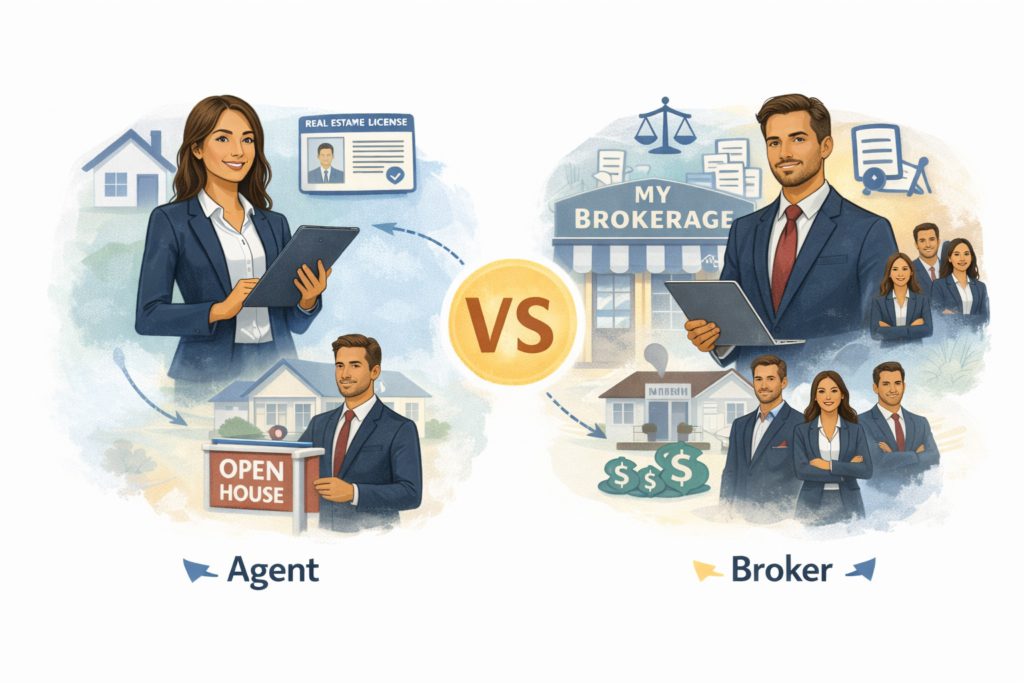
A real estate agent and a real estate broker are both licensed professionals who help clients buy, sell, or rent property. But their roles, responsibilities, and earning potential are different. The distinction lies in how independently you can work, whether you can run your own brokerage, and how much legal responsibility you carry in a transaction. The following table breaks down the key differences
| Real Estate Agent | Real Estate Broker | |
| Licence level | Entry-level licence | Advanced licence |
| Can work independently | No | Yes |
| Must work under a broker | Yes | No |
| Can open a brokerage | No | Yes |
| Can hire and supervise agents | No | Yes |
| Legal responsibility | Limited | Full responsibility for compliance and agents |
| Handles client escrow funds | No | Yes |
| Signs contracts as brokerage | No | Yes |
| Income source | Commissions from transactions | Commissions + agent splits + fees |
| Commission split | Shares commission with broker | Keeps full commission (if solo) |
| Startup costs | Lower | Higher (insurance, compliance, trust accounts) |
| Administrative workload | Low to moderate | High |
| Focus of the role | Sales, client relationships | Sales, management, compliance |
| Career entry point | Yes (where everyone starts) | No (requires experience) |
| Time to qualify | Immediately after licensing | About 2 to 4 years after becoming a licensed agent |
| Common career path | Agent → Top producer → Team lead | Agent → Broker → Brokerage owner |
| Typical long-term choice | Many stay agents | Fewer advance to broker |
Final words
Becoming a real estate agent in the US about committing to a long-term, relationship-driven career, not just becoming licensed. If you want to be successful, treat the career as a business, not a side hustle. Be prepared to focus on consistency, follow-ups, and local expertise rather than quick wins.
Over time, growth comes from sharpening your skills and building trust with your niche. Just as important are the tools you use to streamline your operations. A reliable CRM like Privyr can help you manage relationships better; a strong marketing system helps you stay visible; and data-driven insights help you guide decisions.